

PodCastle 948: DOUBLE EPISODE: How I Did Not Make Friends With Teniel eu Letxie and The Gift of Her Light
Show Notes
“How I Did Not Make Friends With Teniel eu Letxie” Rated R was previously published in Baffling Magazine, Issue 14, January 2024
“The Gift of Her Light” Rated PG-13 is a PodCastle original.
How I Did Not Make Friends With Teniel eu Letxie
by Bree Wernicke
Two drinks, and I start telling people I can do syokk.
Is that entirely accurate? No. Can I stop myself? Also no.
The party is at my frenemy Eurli’s flat, and she air-kisses me hello as I push a bottle of my least favorite brandy at her. “Didn’t you bring anyone?” she asks, but fuck if I’m going to knowingly inflict Eurli on another human being. I shrug at her and escape to the drinks rack. I don’t recognize anyone here so this’ll suck unless I start talking to people, and fast. I hi-my-name’s-Gebrenie-what’s-yours around the place until I wind up in a circle of people sprawled on cushions, one-upping each other.
Well I had my very first paper published in Magic.
Well I got that grant for thaumoquantum transference; trials begin in City Brenetxie next month.
Well I just got off the waitlist for a Triu Tetxe wand.
“Oh, you’re all magicians,” I say.
Nods all around. “Aren’t you, Gerit?” someone says.
“Gebrenie,” I say. “No, I never picked it up properly. But I did learn a little something when I was younger.” Not the Brenetxie magic they’re talking about, though.
“Aw, show us then!”
“Yes, you must!”
Credentialed magicians love nothing so much as watching an amateur struggle.
“Couldn’t possibly,” I say, because you have to, but I set my drink on the floor, because I am a showoff.
“We can give you some tips,” one of the magicians says sweetly.
“Loooove tips,” I say. But instead of pulling a cheap wand out of my bodice, I close my eyes and lock my hands together. And — my mind blanks.
Oh shit oh fuck. Did I really forget how to start?
I haven’t really done syokk in over a decade. I tell myself I can still do it if I want to, because it’d be sad if I couldn’t. I used to love it. I still love it. But do I practice? Nah. It’s depressing practicing alone and I can hardly show up to the Cultural Center Ingaraadie on my own, looking obviously Ebrenetx. What would I even say — “Hi, I swear I’m not a total weirdo with an unseemly interest in your traditions! I just learned syokk when I was young and want to practice!” — which sounds suspiciously like something a total weirdo would say.
Somewhere in the midst of my drunk blanked-out panic my second-year teacher’s voice floats into my head. Start with breath. Go as slow as you need to. She’s speaking Tuibrenetx, not Ingaraapk, which isn’t right, but hey. It works. I remember, and I breathe. The sensation gathers between my palms. I open my eyes to a froth of cinnamon-colored light around my fingers, shapeless and faintly warm.
Fuck, I’m rusty. The light is supposed to be clear and strong, not . . . bubbly. But it’s workable. I poke and prod at it until it starts reacting, like a glob of taffy. Draw out a glimmering, uncooperative neck, and a set of fins because triangles are easy, and then I have something like . . . a giraffe shark? Not fancy. Just a stupid party trick. Magic from a place that never wanted me anyway.
The magicians have gone silent and stony, the syokk-light glazing their faces dark red. One girl’s leaning forward, something sharp in her eyes. With a jolt, I recognize her.
“You know syokk,” she says.
Teniel eu Letxie. We’ve only met once before, but I know more about her than I should. We run in the same circles. Not friends — yet. Online she’s pretty loud about Ingaraadz politics. (She’s half, Eurli told me last week. The famine brought her grandparents all the way here. And they’re dead now.) Teniel probably does gorgeous syokk. Builds whole myths out of light one-handed. And here I am with a lumpy little glob. She’s about to tear me apart.
“Only a little,” I protest.
Her gray eyes bore into me. “How’d you learn?”
Online class, an Ebrenetx might say. Saw a traveling exhibition and became enamored of the art. Ingaraadie stuff is just so cool, you know?
“I, uh, I learned it in primary school. In Ingaraad,” I explain. A more legitimate reason than most Ebrenetx have. “I grew up there. Well, almost. Not entirely. Just a few years.” (Two. Barely.) “Then we moved back here.” Teniel’s not saying anything. My syokk begins to flicker. “But, uh, yeah, in school we did syokk every morning, after math. I’m not very good anymore, as you can see, but uh . . .” I gesture vaguely with both hands, and my giraffeshark bobs along like a deflating balloon. “It’s fun!”
Fun. I hate myself.
The magicians are getting up, making noises about drinks, but Teniel crawls onto my cushion. Oh no, she’s going to clap in. I’ll have to pull out all the stock patterns I still remember, and hope she gets bored before I drown in the light like the fraud I am. I grit my teeth and yank some Ingaraapk out of a dark corner. “Syokk-n lluwty?” Shit damn fuck, wrong tense. We practiced syokk? I sound like a dumbass. Worse — she hasn’t even told me she’s Ingaraadz yet.
She just stares at me, and my will to live shrivels. I hope I black out and forget all of this.
“Sorry,” I mumble. My giraffeshark falters and melts into nothing.
Teniel watches it go without expression and then says abruptly, “I can’t even speak it. Let alone practice syokk.”
Horrible relief. I almost laugh, but that’d be ghoulish. “Oh,” I say instead.
“I didn’t want to learn, growing up,” she says. “And no one pushed me to. But now I regret it.”
“You could still try,” I say. “Online class?”
But we both know that’s bull. Childhood acquisition windows and all that. You’d never get more than a tiny glimmer up, starting after age twelve.
“Or I can teach you what I know,” I say, too eagerly. I shouldn’t even care. Why do I care? It’s weird that I care. “But, you know, like — I’m really bad now. I used to know way more. And it all — faded. And I don’t know if I can ever get it back.”
Teniel looks at me for several seconds too long. “Well, I never even had it at all,” she says. “Your plesiosaur was cute, though.” She drains her drink and rises from the cushion without a backward glance. “Good talk, Gebrenie.”
In Brenetx, that’s a friendly enough goodbye. In Ingaraad, it’s fuck you.
I know which way she meant it.
The Gift of Her Light
by AnaMaria Curtis
Solenie, the songbird of the South, the most beautiful woman in the world, or at least the province, unpins her hairpiece from her scalp and coils it carefully in her bag. She catches my eye in the mirror.
“I can feel you doing it, Rowan,” she tells me, and there’s laughter in her voice. Her face is pink from scrubbing off her makeup, and her brown eyes are bright.
I don’t bother telling her that I didn’t even make these candles, that I couldn’t make the light in the dressing room bend in her favor even if I tried.
I smile instead, as if she’s caught me. “How can you tell?”
“It’s the way people look at me.” She makes it sound like a confession. Her hand reaches for the neck of her robe, like she’s afraid it’ll slip. “Nobody looks at me like that in the daylight.”
“Sorry,” I say. “Must be habit.” I don’t point out that the only person looking at her right now is me.
When we arrive in Zuri-zan, the nightclub owner only has half of what he promised us. I call him a lying piece of shit and tell him we won’t perform the last two of the four shows if he doesn’t have the rest for us by then. He pushes my shoulder, testing me, and his watch catches the lapel of my suit. When I don’t react, he asks Solenie, silent and regal behind me, if she picked me as her manager and traveling companion because I’m the ugliest woman in the world and it makes her look good in comparison.
Usually, they just call me ugly without bringing her into it. I can’t decide whether to laugh or cry when she puts a hand on my shoulder and tells the man to fuck off in her nicest accent.
After that, we have a week off before ten days in Dordell. Solenie visits her parents, who will no doubt spend the whole time telling her she could be traveling with someone as beautiful and talented as she is, instead of a girl with a face like a dog’s who wears too-big suits and tries to fight Solenie’s battles for her. I spend it making candles.
It’s hot for autumn, even before melting wax is involved. I sweat over everything; the long, thin molds for the chandeliers, the thick tabletop candles, the coil of the uncut wicks. There’s hot wax on my hands and the sleeves of my shirt. It will leave discolored markings, drabs and dots, which no one will bother to see.
Solenie always worries we’ll run out of candles, has visions of standing on stage suddenly revealed, shorn of all her beauty in an instant, as the candlelight fades and harsher lights strip her down to nothing, make her something I can’t shape.
I don’t know how to tell her that it’s not my gift with candlelight that makes her beautiful, so I just make more candles. Pack more candles. Promise her I’ll always be there in the shadows, making her something nobody can look away from.
A few days in, Solenie comes to visit, saying she needs a break from her parents. I let her help me with a batch of smaller candles. She winces in sympathetic pain when the wax strikes my wrist.
The last evening before we set off for Dordell, I take one of the misshapen castoff candles to the mirror. When I was a kid, learning to mold candlelight like clay in my hands, I could practice on myself. I would move the light over my own face so that the line of my hair blurred, so that my cheeks looked less round and my nose less crooked.
It stopped working sometime around my thirteenth birthday. Ma said that was normal. Some tricks we can’t play on ourselves, when we know we’re the ones doing it.
I look at the person in the mirror and try anyway. Short blond hair, weak chin, flat mouth.
It doesn’t matter how I push and shove the light around it; I always look the same.
The theater in Dordell is so nice it almost makes me wish we’d bailed on that nightclub in Zuri-zan after all. It has big chandeliers hanging from the ceilings above the stage and a thick candlestick holder for Solenie to hold while she sings. They grumble when I make them swap out their candles for mine, but I just wink and tell them it’s part of the performance.
That first night, the audience is restless. They haven’t heard of her; we rarely come this far north. As they wait, I keep the shadows long, emphasizing the emptiness of the stage from my place in the wing.
The curtain rises; Solenie steps forward, a candle in her hand. The moment before she starts to sing always requires the most concentration. I have to build the anticipation but also emphasize her beauty, turn it magical. I mold the light around the graceful white column of her neck, the round sweep of her jaw, the pert point of her nose. Her mouth opens, and the candlelight catches on her eyes and on the red gleam of her lips.
The crowd holds its breath. Solenie entrances us all.
When the curtain falls, Solenie keeps the candle alight. She looks toward me, and she smiles.
Afterwards, in our hotel room, Solenie asks me if I can teach her how to mold the light. Her long dark braid falls over her neck; the loose collar of her nightgown is about to slip off her left shoulder. I try not to fixate.
“Come on,” she says, when I hesitate. “Rowan, please.”
“Why do you want to know?” I ask, when I mean, why now.
“If I understand it, maybe I won’t feel like you’re turning me into something I’m not.” She swallows. I watch. “Maybe I’ll stop wondering when it’s all going to end.”
I sit up. “I’m not. I would never . . . Solenie, I’m just trying to show them what you are.”
Her eyes are intent on me. She’s not swayed. “You have to show me,” she insists. “Show me what you show them.” She’s calm, focused. I know her well enough to know she will not be convinced to forget this.
I open my mouth, out of arguments. This is what it comes to, what is impossible to tell her: with the candlelight, I’m only letting the world see what I do. She is beautiful to them because she has always been beautiful to me.
And when she sees that, when she knows that, she won’t need me anymore.
But perhaps it’s for the best. Maybe she doesn’t need me fighting her battles and inserting myself where I’m not needed anymore.
“Okay,” I tell her. “I’ll show you.” Her hand is outstretched; I grab her wrist, a plea for mercy she doesn’t understand yet.
I fumble around in my bag for some of the candles I let her help with. We both made them, so they should work for either of us.
We take them to the mirror, and I show Solenie exactly what I do when she is onstage. I let her see the way the light bends toward her, how it emphasizes what is already there, what I have always seen.
“Oh,” she says, and there are layers of meaning in her eyes when she turns to me. She doesn’t turn away. She doesn’t smile, either. Her task is only half finished. She reaches for the candle. “Now teach me.”
I guide Solenie through the basics, how to smooth light, expand it, how to deepen or lighten the shadows it casts. How to turn it on someone else and put feeling behind it, to make others see what you do, almost a simple mechanical trick.
In return, Solenie takes the light from her candle and casts it over my face. In the mirror, I see myself transform the way I haven’t since I was twelve. Solenie’s light emphasizes the shadow beneath my jaw, makes my nose stronger, my eyes brighter. In the mirror, I am a protector. Strong. Trustworthy. Beloved.
She sees me the way I have always wanted to be seen.
Host Commentary
…aaaaand welcome back. That was “How I Did Not Make Friends With Teniel eu Letxie” by Bree Wernicke, and if you enjoyed that then there’s a whole bunch of flash and short fiction linked from her website, breewernicke.com, behind—you’ll be amazed at my internet sleuthing here—the “fiction” button. Though it should be noted there are also “Poetry” and “Plays” buttons, if that’s also your style!
…aaaaand welcome back. That was “The Gift of Her Light” by AnaMaria Curtis, and once again my incredible Internet Detectiv…oring has uncovered a list of further publications for you to read! It’s behind the “Publications” button at anamariacurtis.com. Honestly, you lot would be lost without me; how else would you have found those stories at Uncanny, Strange Horizons, Clarkesworld and all those other really well known magazines which are probably also on your podcatcher anyway.
So, full confession time, no secrets in these outros from me as you well know by now: I read this pair of stories, then asked Devin and Wanini in the group chat, all innocent like, what they thought the link between these two was, in their opinion? Cos I’d read them both, enjoyed them both, and come out with… friendship is magic?
Luckily for you lot, Wanini is cleverer and more insightful than I am—though, alas, also busier, so not able to tell you this themself—and summarised it rather beautifully as “they both speak to the tension between how one perceives themselves and one’s social positioning”.
Which is rather elegant, really, isn’t it?
Because there is a tension between those two: a social pressure, a weight of opinion trying to overwhelm and crush what you otherwise feel to be true. You may have heard of the Asch Conformity Experiments before, where 11 actors were positioned as fellow subjects alongside one true test subject, and primed to give obviously wrong answers to a simple question on comparing the length of two lines before the true test subject was asked for their response. From a control rate of only 0.7% incorrect answers, the test subject instead went along with the obviously wrong majority 35% of the time.
Now it is true that a majority of the time, people did still give the correct answer despite the social pressure otherwise, and that even in that 35%, a number—when interviewed afterwards—knew the others were wrong but went along with the majority to avoid conflict. But there were some who were genuinely influenced by the majority to the point they could no longer perceive the test accurately, and—more to my point here—all these figures are on the basis of a test that was unambiguous, objective, straightforward and with no value judgement or consequence either way.
I warrant that when it comes to something as complex and subjective as the social web, then, not to mention that emotionally fraught, that social influence is rather more powerful.
It might lead us to think that the interesting path our life has taken should be kept quiet and hidden, because it’s better not to stand out and draw attention to the ways in which we’re different, and in doing so we miss out on the genuine connections that might otherwise have been made, that only we could have made because of those differences.
It might make us think our place is only on the sidelines, and that we are only a support part to people who were made for the spotlight: and it’s all too easy to slip from “not standing in the spotlight” to actively choosing to stand in the shadows, instead, hiding yourself from the world in every situation.
Normally this is the part in my script where I try to give some kind of solution, direction, call to action: except I’m buggered if I know how to avoid the issue. I’m as vulnerable to it as anyone. I’ll change my whole self in an hour to fit into a crowd, I’m awful.
But I’m trying to be more aware, and trying to ground myself and remember that there are people who actually seem to like me for me—one of them even married me! And is still hanging around, 16 years after that!—and so if I’m good enough for them as I am, I ought to be good enough for others, and if I’m not… well, you can’t please everyone, and that’s okay.
Not that knowing a thing intellectually means a damn thing, sometimes, but it’s a start, y’know?
About the Authors
AnaMaria Curtis
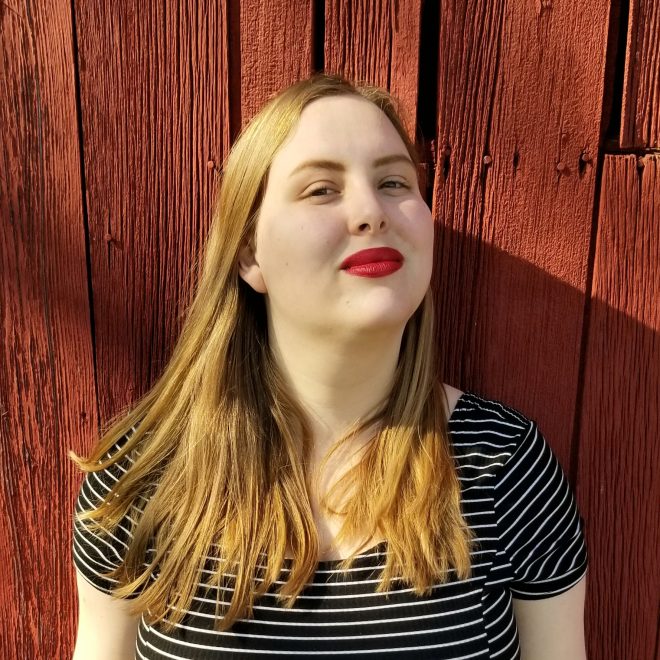
AnaMaria Curtis is from the part of Illinois that is very much not Chicago, where she learned to be argumentative, competitive, and nostalgic. Her work has been published in magazines including Clarkesworld, Uncanny, and Strange Horizons. You can get in touch or find more of her work at anamariacurtis.com or on Bluesky at @anamariacurtis.bsky.social.
Bree Wernicke
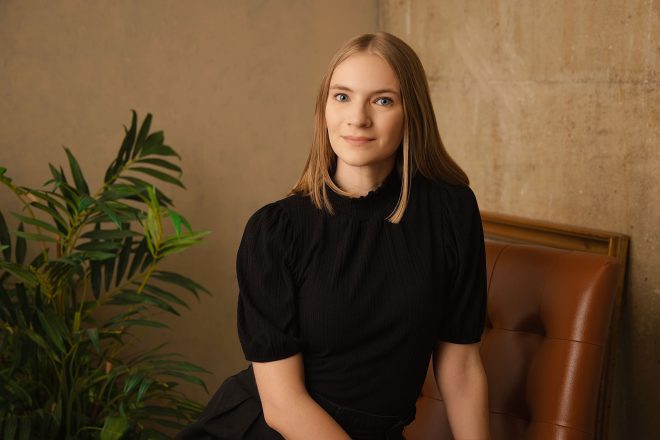
Bree Wernicke is an actor and speculative fiction writer based in Los Angeles. Her work has been nominated for the Rhysling Award and can be found in Strange Horizons, Bourbon Penn, Small Wonders, Fusion Fragment, and more.
About the Narrators
Kat Kourbeti
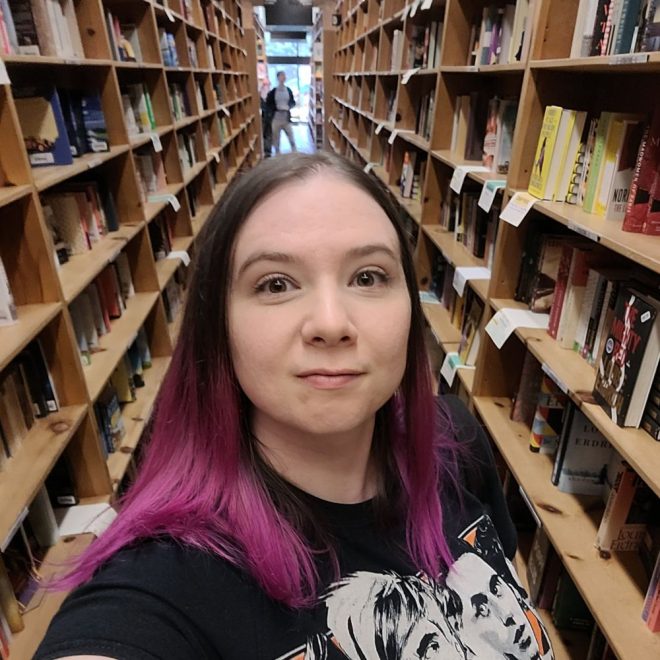
Kat Kourbeti is a queer, Greek/Serbian speculative fiction writer, culture critic, narrator and podcaster based in London, UK. She is a Hugo and British Fantasy Award-winning Podcast Editor at Strange Horizons magazine, hosts The Write Song Podcast, and writes about SFF arts and theatre for the BSFA. She also organises Spectrum, London’s SFFH critique and community group, while her day job is in theatre. Find her on all social media as @darthjuno.
C. L. Clark

C. L. Clark, dubbed the “Patron Saint of Sword Lesbians” by Reactor Magazine, is a BFA award-winning editor and the Nebula-nominated author of a few essays, several short stories, and a handful of books, including the Magic of the Lost trilogy (The Unbroken), the novella Fate’s Bane, and the Arcane novel Ambessa: Chosen of the Wolf. When they’re not imagining the fall of empires, they’re trying not to throw their kettlebells through the walls. For essays and extras, head to their website, clclarkwrites.com.
