

PodCastle 967: How to Come Back to Yourself
Show Notes
Rated PG
How to Come Back to Yourself
by Audrey Zhou
Lilin is the kind of small divinity that doesn’t invite notice.
She isn’t one of the gods that has to hide deep away from civilization, to avoid the notice of humans; Lilin’s only anchor to divinity is her shadow-self — her shadow in mostly the traditional sense, if shadows had their own minds — which she tries not to think about. Lilin keeps her home on the edge of the forest, down the path from a village she used to do business with.
Of course, it’s been a long time since she’s gone to the village. It’s been a long time since she’s been brave enough to do business.
It’s been so long that Lilin figures herself forgotten by anyone that would bother to look for her, so when the young man emerges from the forest, she forgets to pretend to be anyone other than herself.
“I hear you are a prophet,” he says.
He looks her age — he looks human, even: tanned skin, dark hair falling into his eyes, broad shoulders. But he’d managed to find her, and his eyes are golden like pale sun, and there is a sureness to his voice that makes Lilin suspect he’s tangled up with divinity, just like her.
“Of a sorts,” Lilin says, because prophecy is a loose word for what she divines through her shadow-self. “But it’s been years. I’m not — I don’t do that anymore, not really.”
“Are you sure,” he asks, “that you can’t be convinced?”
The man’s name is Jun, and naturally, he wants a prophecy of the future.
Lilin is hopeful, briefly, that he means just for himself, but he continues: “Planting season is coming up in the village. I hear you used to give prophecies for the crops.”
Ah. Alone, Lilin sometimes loses track of time, but it’s true that the scent of plums in the air has been replaced with orchids. It’s spring now, time to prepare the fields for the summer.
“I haven’t seen you in the village before,” Lilin says. She would have remembered someone like him.
Jun hesitates. “I only recently moved,” he says. “I’m here because I owe Granny Yao a favor.”
Lilin isn’t quick enough to smooth out her expression, remembering guiltily the unopened letters from the spiritual messengers Granny had sent, tucked away in her drawers. Jun’s head tilts with interest, but he’s kind enough not to say anything.
“I can’t control the prophecies,” Lilin explains. “Even if I did give you one, I couldn’t guarantee that it would be something you wanted.”
“Prophecies don’t always come true,” Jun says, reasonably, as if he isn’t here asking her for one anyway. “But when they’re good and they do, they’re worth it.”
Like taking a wager. “But if they don’t?” Lilin challenges. “Or if they’re awful?”
“I’m okay with an inauspicious prophecy,” Jun says, with the air of someone used to bad news. “Granny, too.”
“Sure,” Lilin says. “But I’m not. And I mean it, when I say that I can’t.”
“At least pretend to think about it,” Jun says. “You know Granny Yao. Once she has her mind set on something, it’s hard to convince her otherwise.”
His attention shifts to Lilin’s house. Lilin used to deal in trades: it used to be that she would speak prophecies for the carpenter, who would come by every season, and for Auntie Shen, who stitched up Lilin’s clothes for her.
Lilin is good at providing herself food with the garden, but her talismans don’t do everything.
“I can help you out in the meantime,” Jun says tactfully, eyes drifting to the thatching on the roof. “If you don’t mind me hanging around.”
A prophecy is nothing but a suggestion, a possibility plucked out of a sea of possibilities to be made more probable. The future cannot be controlled, but maybe it can be coaxed.
Lilin has heard various ways of finding prophecies — reading bones, divining at birth through the stars, physiognomy — but it all boils down to the same thing: a prophecy is a way of giving something power. It’s a kind of magic: when you speak something into existence, even if it is only a suggestion, it solidifies a little. Grows tangible. Becomes that much closer, to being a future, if someone puts enough belief into it.
The larger divinities, when they roamed the world freely, could coax wars to life and famines to sleep. But Lilin’s customers came to her for smaller problems, like root rot prevention or weather prediction.
It was Granny Yao who taught her, when Lilin and her shadow-self had stumbled upon their little village by the coast. Lilin hadn’t understood yet what it meant for her shadow-self to whisper into the world alongside her, only that it seemed life was easier when she could give herself grace, and that it was worse when she couldn’t.
The prophecies don’t always come true, of course, and Lilin only has so much control over them. Intent only goes so far. Still, she does her best to only speak good futures into the world, or to at least temper the bad ones.
There was a time Lilin could speak a prophecy alongside her shadow-self and the words would feel like air on her tongue, so easy. Then there was a time Lilin would wrestle with her shadow-self and lose.
In the end, Lilin couldn’t coax her shadow-self into synchronicity, into doing what she wanted, and she couldn’t even convince it to stay.
Now, Lilin’s shadow-self has gone away to places Lilin can’t find.
Jun winces at the state of her door and the furniture in her dining room but looks pleasantly surprised at the garden. He doesn’t balk at the talismans littered among the plants, to promote growth and ward off insects — Lilin has gotten acquainted with small magics, in the absence of the ability to trade for good old-fashioned human craft.
But he does look at her, Lilin in totality. Lilin, how her body doesn’t intercept light as it should.
“Your shadow,” he observes, surprised. “You don’t have one?”
“I do,” Lilin admits. “But it’s — I can’t find it. That’s why I can’t give you what you need.”
Jun nods, understanding. He has a shadow in the true, traditional sense. Yet —
“I’m many-selfed in a different way,” he tells her.
He is human and then he is not; he folds up, collapsing into a coil of scales before shuddering into the orange-pelt of a fox, and then he grows small again, winged and feathered. Lilin marvels at the careful flex of muscle, waxing and waning under his skin; Jun slips into forms like water freezing into ice and then melting again.
“When I was born,” Jun explains, “the fortune-teller said my doom was inherent, that it was spelled within me. So I kept collecting new forms. I kept trying to find new fortunes for my new selves.”
Lilin doesn’t ask if any of the previous prophets Jun visited told him anything different. That he didn’t say is answer enough.
“So you went to Granny,” Lilin surmises. Granny Yao specializes in a variety of magics; she’d been training Lilin to take over the prophecies, so Granny could devote her own energies to helping other parts of the village. “Did she give you one?”
“I’m still completing her favor,” Jun hedges.
“Sometimes a prophecy is only a story, anyway,” Lilin says, reflexively. “They don’t have power until you believe in them.”
This is something she used to tell all her customers, when she still had them, to soothe their fears in either direction — if she spoke of something good and it didn’t come to pass, or if she spoke of something bad and it did.
It’s something Granny used to tell her, too.
Granny’s first lesson for Lilin:
“The thing about you,” Granny had said gently, when Lilin had come to her crying about her failure to predict a faster recovery for a bird she’d found on the ground, broken-winged, “is that you need to realize you aren’t telling a truth, when you give a prophecy. You make something more likely to happen, when you speak it, but you don’t make it a certainty.”
“But why would you ever take that chance?” she’d asked. “Why prophesize at all?”
The two of them had been in Granny’s kitchen. The bird, transported out of Lilin’s clumsy care and into Granny’s, already seemed happier. Lilin watched it flit around on light feet despite its crooked wing, exploring the feed Granny had set out for it with great interest.
“You can make happiness more tangible,” Granny had told her, with the wisdom of someone who had seen infinitely many things come to pass. “Or you can do that to fear.”
The last prophecy Lilin gave, it was summer in the village. The area was prone to wet summers, ordinarily, but there had been a period of drought, long enough to be uncomfortable for the farmers’ crops.
Lilin, in past seasons, had managed to speak of increased yields, steer futures closer to prosperity. But she’d never had to try something as big as a drought. Lilin’s wisp of divinity was nothing like the gods of old. In her anxiety, she fumbled small prophecies, even things as little as predicting whether or not Uncle Fu’s batch of baozi would steam well.
When Lilin is afraid, her shadow-self feels it even worse. She should have known from the beginning that trying to foresee when the drought would end wouldn’t work out.
“If you don’t feel up to it,” Granny had told her, that morning, “it’s alright. We can try other things.”
But Lilin was stubborn. She wanted to be useful, even if she didn’t fully trust that she could be. “We can try this first,” she’d said.
So Lilin had gotten up in front of the crowd that had gathered in the village square. She felt the familiar weight of her shadow-self in the back of her throat, and she spoke, voice twined and two-toned:
The dry spell will stretch for weeks still. The wind will take the rains further away, to the north. For months, the dust left behind will turn up on every spare surface.
After, Lilin couldn’t bear to go back. She disappeared to the forest and tried to bind her shadow-self away. To divorce it from herself.
She waited until the sun was highest, when her shadow-self was smallest, and she caught it in talismans in her garden. Caught is perhaps not the right word — Lilin wonders now, looking back, if her shadow-self wanted to go. If it felt as guilty as she did.
She hadn’t meant to do anything, really. Just hold it, temporarily, in a place where they couldn’t reach each other. Just so she could get some space for herself.
The next day, Lilin’s shadow-self had disappeared. The rain didn’t come for months after, and when it did, it washed away the plants that had grown brittle and wilted with disease. That year, the village lost acres and acres of their livelihoods. It didn’t occur to Lilin until later that maybe her own lack of belief in her ability to coax something good out of the situation could have amplified the catastrophe of it all.
Granny wrote to her for months after. Even now, every so often a letter comes.
But Lilin leaves them unopened. How do you face a thing like that?
Jun is a persistent visitor. He comes up and down the winding path from the village with regularity, bearing news Lilin has remained isolated from in her shame.
“Auntie Shen has started on a new line of skirts,” he reports one day, “though she laments that there is no one to wear them.” The next: “Uncle Fu has seeded his farm with rice and peanuts.”
He doesn’t speak of Granny, though she’s the one Lilin wants to hear from most of all.
Jun comes on foot most days, though doubtless it would be easier for him to fly. Or run, fleet-footed, fox-wiled.
“You don’t seem to like some of your forms as much as the others,” Lilin observes one day, carefully.
Jun laughs, wry, from Lilin’s front steps, where he’s sitting and weaving together some tall, dried grasses to patch up her roof with. “You mean that I prefer to stay human,” he says. “It’s my newest form; it’s the only one I don’t know my fate for, yet.”
“Believing things gives them power though,” Lilin says. “So you believe what they said?”
“I don’t not believe it,” Jun says. “But I can’t help the shapes I’ve taken.”
Lilin considers her missing shadow-self. Unmoored without it, Lilin is light, light like she might fly away, wisp into the clouds and disappear. She used to think maybe she’d like that, freed of burden and worry. Now though, she just finds herself missing her anchor.
“Do you think I’m lucky, for what’s happened to me?” she asks. If Jun could erase a self and erase a fortune, would he?
“That depends on what you want,” Jun says. “I don’t want to be followed by my fortunes. But at the same time . . . I have never lived without them hanging over my head.”
“I haven’t ever been a person without my shadow-self,” Lilin says. “But I don’t need it to be a person.” She had to make her peace with this, in the aftermath of the split: half-selved, she was still Lilin.
“You don’t have to be anything at all, to be a person,” Jun agrees. “But it’s okay to want things.”
“It left me,” Lilin says. She coughs, has to clear her throat to stop her voice from cracking more. “I didn’t — it wasn’t what I wanted, for it to go.”
Jun cocks his head. Like this, he is bird-like, so much that Lilin is startled that he’s unfeathered. So much so that Lilin imagines she can see all those other forms of his, the echoes of him, like firelight against paper at a puppet show bleeding through his skin.
“But do you want it to come back?” he asks.
Lilin doesn’t feel like herself; she doesn’t know if it’s possible to get back to a time when things were good, when living with her shadow-self felt as easy as breathing. But surely she can get to a time where things are better.
Spring grows older; the air warms with new heat. Lilin’s shadow-self does not come back, and still Jun keeps hanging around.
Though Lilin knows that he doesn’t like it, sometimes Jun will shift to perform tasks for her. He catches game for the two of them when he is a fox. If Lilin needs herbs, he shifts into a bird and goes foraging. Sometimes he nestles close to her, his snake-body susceptible to the cold even with the changing temperatures, and Lilin will put her hands to the cool, dryness of his scales, privately thrilled at how the shifting muscles feel underneath her fingers.
Watching Jun get familiar with his selves, she can’t help but miss her second self.
This afternoon, Jun is human. He’s making a trellis for her, to support the plants as they climb. Lilin had been pruning and then weeding, but mostly she’s there with him just because she wants to be.
“How did you get your new forms?” Lilin asks.
“I studied,” Jun says, laughing a little at himself. “You wouldn’t believe how long I spent birdwatching. I went part by part, feather by feather, until I could imitate the whole.”
“Have you ever lost any?”
“There are ones that don’t come as easy anymore,” Jun says. “But that makes it easier for me to learn new ones.”
Loss, change; transformation. Lilin and her shadow-self can’t coexist the way they used to, not if they’re still the same as they used to be.
“Is this why Granny sent you?” Lilin asks. “To convince me to go back? To believe that I could?”
If Jun came bearing one of Granny’s letters now, Lilin thinks she could open it. She’s not sure she’s ready, but she wants to be.
“She refused to give me a prophecy, for my new self, after I told her about all the other ones I’d received.” Jun admits. “Said I shouldn’t worry about such things. But she told me you were here, that you might give me one if I wanted one so badly. So I thought I’d start with just getting to do them again before I asked you.” He pauses, glances at her sidelong. “But I’m not here for a prophecy, really. Not anymore.”
“I can’t want the prophecies back just because of you,” Lilin says. “Or just because of the village.”
The dual implications of their statements, laid bare like this, come to her too late: that maybe it’s Lilin keeping Jun here. That maybe Jun is important enough in her life to push her towards finding a way to prophesize again.
Jun’s mouth is slack, gentle with surprise; his eyes, all careful wonder. “Of course,” he says. “But you can want other things, too.”
Lilin swallows. “What if I mess up?” she asks. She’s talking about the prophecies, but she isn’t talking just about them.
Jun laughs, startled. A sound shocked out of him, a sound that sings with abandon. “Then you mess up,” he says, and he isn’t just talking about the prophecies, either. “You can choose happiness, Lilin, or you can choose fear.”
It’s a strange thing, courting her shadow-self.
Lilin tries to show that she is apologetic. She recollects their shared youth and leaves the things the two of them used to like in the garden, as offerings: orchids, fresh buns filled with red bean. She wakes in the early morning and keeps watch in the late afternoon, when the sun is low; the shadows are longest, then. Maybe that could be enough for Lilin’s to want to come home.
Jun, who has taken to sleeping beside her at night, fox-shaped or snake-coiled — there is a courtship of another nature, happening with Jun — asks, “It’s a reflection of yourself, a little bit, right? Where would you have gone?”
So at the end of the planting season, Lilin goes to the village, to the market. Jun volunteers to accompany her, but Lilin takes the journey alone; he’s been the buffer between her and Granny for long enough.
Still, she almost turns around twice, going down the path. She cringes away from familiar faces that shine with surprise when they see her; Lilin looks at them only long enough to make sure that their faces aren’t hollowed out with hunger. That her mistakes didn’t travel downstream for too long.
Granny opens the door before Lilin has the chance to knock — she’s lovely, silver-headed and clear-eyed. She smiles, wry, at Lilin’s surprise; that Lilin has managed to forget how Granny has a knack for knowing things will happen before they do.
“I thought I would have seen you sooner,” Granny says, but she doesn’t sound angry. “Come in for tea, won’t you?”
Lilin can’t run, not now, not anymore. So she goes inside.
It feels remarkably normal, despite all the time that’s passed. Granny sits Lilin at the kitchen table and serves them barley tea. She must notice Lilin’s lack of shadow, when Lilin lifts her hand to reach for her cup, but Granny doesn’t mention it. She just raises her eyebrows as she pushes a plate of red bean buns at Lilin and says, “So. I hear you and Jun have been getting along.”
Lilin flushes. She hadn’t come prepared to talk about Jun, or to endure Granny’s gentle ribbing. “He’s very kind,” she says, lamely. “It’s been nice to have him around.”
Granny’s smile is self-satisfied. “I thought he might be good for you,” she says, and the fond, knowing look on her face is enough that Lilin finds the courage to bring up the last time they saw each other.
“I’ve missed you,” Lilin says. Granny watches her, silent, so Lilin continues, clumsy. “I’m sorry about everything. The drought. Leaving. I didn’t know how to stay. I didn’t — well, clearly one part of me knew how to run.”
“The thing about you,” Granny says, like a second chime of something she told Lilin long ago, “is you take everything onto yourself no matter if you should or not. All that happened was a mistake that we have systems in place for. Water rationing procedures and dried stores of food. Didn’t it ever occur to you that you might have been more helpful to us here than away?”
Lilin swallows. “I’m sorry,” she says. “If I just hadn’t said anything at all —”
Granny sighs at her, so familiar in her exasperation that it almost doesn’t sting at all. “Don’t be sorry for the drought,” she says. “Or for trying. Just be sorry that you haven’t come to see me in ages, that you’ve forgotten how it is to take tea with me.”
“What did you write in those messages?” Lilin asks. “Did you know that my shadow-self was gone? That I couldn’t give prophecies anymore?”
Had Granny been disappointed? Did she regret passing her teachings to Lilin, that Lilin was unfit to execute them properly?
“Go to my room and get the letters on my desk,” Granny says. “I hadn’t sent some of them to you yet.”
Lilin’s hands shake a little, when she picks the papers up, when she returns back to sit under Granny’s scrutiny. But she’s already made it all the way here, and she wants this. So she reads.
Lilin flips through the first page and then the next. “You — what is this?” she asks. “Are you sure you addressed this correctly? These are for me?”
There aren’t any reprimands, or lectures, or even condemnations. It’s gossip Granny’s written in the letters, the kind of stuff Granny would have told Lilin about in person, if only Lilin was there to hear it. A mundane kind of love. Granny’s written about Uncle Fu and how the tanghulu seller keeps hanging around his food stall and making eyes at him. She’s written about Auntie Shen and how she keeps nagging her daughter to hurry up and get married already.
When Lilin looks up, Granny is watching her tenderly.
“I only wanted you to come back,” Granny says, “to see if you were alright. So you’d know you still had a life here, if you wanted. Even if you decided never to prophesize for the village again — you know I wouldn’t care about that. Not if it was something you decided for yourself, and not just something that you thought the rest of us wanted.”
“My shadow left me,” Lilin confesses. “I put offerings out for it. I wait in the morning and at night for it to appear. I even — I came here, to you.”
She has to look away, unable to face Granny with her heart bared like this, but when she gets the courage to check Granny’s expression, Granny isn’t looking back at Lilin’s face. She’s staring at Lilin’s hands.
Lilin looks down.
It’s been so long she nearly doesn’t understand at first, what she’s seeing: the faint blush of darkness underneath her fingers. The absence of light.
“Just trying,” Granny tells her, “is often enough for a lot of things.”
Lilin’s shadow-self returns in pieces:
An outline of her hands, the dark shades of it curled overtop the vines looping in the garden when Lilin picks a tomato. A penumbral echo, left behind by her steps when she and Jun take walks after their evening meal.
Lilin’s shadow-self grows, new-shaped. It’s smaller than it used to be, thinner. Lilin doesn’t know if there are more parts of it out there still, waiting to be coaxed home, or if it is transformed.
She doesn’t know if it matters. Lilin practices small prophecies now, for the joy of it, and engages with the mundane. She works in the garden and feels her shadow-self curl up around her, curious; together, they prophesize that the tomatoes will grow wild and strong, that it will twine like rope around her feet when she walks in the garden.
She doesn’t bother to be disappointed in herself, about anything. It will be a long while before she performs any big magics for the village, if she ever does again. In the meantime, she gives them her small magics: talismans that protect plants from insects, or to be affixed to clothing to better keep the sun off. She gives them ways in which she can help without being afraid while she learns how it feels again, to stop being afraid.
By the time summer comes to an end, Lilin is sure enough of herself to tell Jun, “I can give you your prophecy now, if you like.”
They’re lazing under the eaves of her home, sitting on the front steps: there is gardening to be done, while it’s still light outside, and Jun has agreed to fix the leg of her dining table today, though Lilin has gone back to her trades with the carpenter.
But Lilin likes this, killing time. Jun is not so shy, anymore, with his forms. Jun is not so shy with Lilin anymore, in general.
In the back of her mind, Lilin’s shadow-self parses through futures:
The fall will pass us by golden and red and orange, languid, like a dream. In the winter we will curl close under the blankets and feel the warmth down to our toes. When spring and summer return, again and again, we will keep holding on no matter what we turn into, no matter what forms we’ll take.
But Jun only shakes his head at her. He’s handsome under the afternoon light: his eyes shot through with sun; the smile on his face, slanted soft and sweet.
“Sometimes,” he says, “a prophecy is only a story.”
Host Commentary
This story was first published in The Tarot of Love from Flame Tree Press. That anthology came out on October 13th, and we’re delighted to help spread the word. You’ll find the link to buy it in the show notes.
Before we begin, a quick word about me: it’s been a while since I last sat in a host’s chair, and I’ll admit I’ve missed it. So, I’m delighted to be back in the saddle here at PodCastle, even if only occasionally. I promise to hand the reins back to Matt in one piece.
…aaaaand welcome back. That was “How to Come Back to Yourself” by Audrey Zhou, and if you enjoyed that, you can find more of her work at audreyzhouwrites.com, or follow her at @aud_zhou on Twitter or @audreyzhou.bsky.social on Bluesky.
And a reminder that this story first appeared in The Tarot of Love from Flame Tree Press, out now. Check the show notes for the purchase link.
And now, a few words from Audrey herself:
“I wrote this story for my fifth week at the Clarion Workshop. This means that I was incredibly lucky to have the chance to workshop this with my cohort, but also that at that point, I’d spent over a month writing frantically, wondering in the back of my mind if anything I was putting out was any good. I love writing, but I’m unfortunately prone to slipping into periods of time in which I’m not sure if writing loves me back.
“‘How to Come Back to Yourself’ is a love story with several courtships, but it’s also a sort of love letter to those feelings of self-doubt and fear. Jun’s character actually came to me before Lilin’s did. I knew that I wanted him to walk away without a prophecy despite his fears about his fate, to have come to terms with his many selves, but it wasn’t until I was nearing the end of the story that I realized Lilin needed to be in the same place. She had to make peace with the fact that maybe she would never be able to give prophecies the way she used to, to want to try again despite it, before she could give them again.”
Thank you, Audrey.
You know, something from Audrey’s note really stayed with me. That fear of putting something out and wondering whether it’s any good, or whether the thing you love also loves you back, isn’t unique to writers. I think most of us have had a stretch where we’ve doubted the thing we usually feel sure of, whether that’s a job, a craft, or just ourselves. What I loved about this story is that it doesn’t treat that doubt as a failure. It treats coming back as something you’re allowed to do slowly, and on your own terms. So, if you’re in one of those quiet patches right now, be gentle with yourself. You’re allowed to take as long as it takes.
About the Author
Audrey Zhou
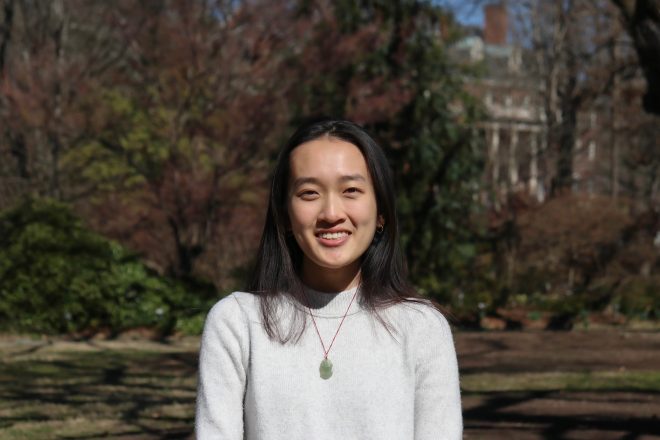
Audrey Zhou is a Chinese American writer from North Carolina. Her short fiction is published in Strange Horizons, Lightspeed, and the anthology Silk & Sinew: A Collection of Folk Horror from the Asian Diaspora, among others. She is a 2025 graduate of the Clarion Workshop, which she will spend the rest of her summers missing. Find her at https://audreyzhouwrites.com, @aud_zhou on Twitter, or @audreyzhou.bsky.social on Bluesky.
About the Narrator
Pine Gonzalez

Pine Gonzalez is a queer, Chinese American/Puerto Rican writer and voice actor from the Chicagoland area. Their writing ranges from romance to fantasy with a focus on telling queer stories. They currently have two completed audio dramas — Tales from the Fringes of Reality and Forged Bonds — and can be heard in shows like WOE.BEGONE, The Grotto, and Fresh Meat. You can learn more about their work by visiting their website pinetreepods.com.
