

PodCastle 966: Closing Aperture
Show Notes
Rated PG
Closing Aperture
By A. E. Lanier
The shapes and colors in the picture solidified and the pile of fur in Maria’s lap came fully into view.
“Aster?” she whispered, her voice catching as she began to cry.
Like many clients, she had been skeptical of the Polaroid camera, but this was why I used it. It felt more intimate to see the photo develop in real time. Connection with the dead was fleeting, and I liked my work to reflect that. I didn’t need records of every haunted house and ghost tour I worked with and neither did they.
But this was no ghost tour.
“Hello, little fluff,” Maria whispered, her fingers gently tracing the still-developing image.
Aster was dead of course, some six months now. But that hadn’t stopped him from curling up in her lap just a few minutes earlier and I was glad to document the experience for her, even if I really shouldn’t be. If he looked a little transparent and washed out at the edges, that was only to be expected.
Maria brushed at her tears and smiled, embarrassed. “I’m sorry, it’s just that the kids were so certain he was there and now it turns out I’ve been lying to them.”
I searched for the right thing to say, grateful as always that children weren’t allowed to be there while I worked. It was hard enough managing the emotions of adults.
“You told your children what you believed to be true and listened to them when they said something different. That seems like exactly what a parent should do.”
“Thank you Emmet, it’s so wonderful having you in town.” She stopped, her face crumpling in shame when she remembered why I was here.
“She was very old,” I murmured. Funnily enough, the exact thing Maria had said to me about Aster half an hour earlier.
Maria saw me to the door and we said the awkward goodbye of two grown adults who hadn’t really spoken since high school, then spent an afternoon hunting ghosts.
Aunt Irene wouldn’t have approved of photographing Aster — her first rule had always been no familiar ghosts. But I made an exception, sometimes, for pets, and it still felt like a fitting way to spend my first morning after her funeral. I was grateful to Aster and Maria for reminding me what it had been like when I started this career half a lifetime ago, what Aunt Irene had seen in the work.
“Mr. Forrester?”
I winced. I was already halfway to the car and hoping I’d successfully avoided Audrey. The Johnsons only lived two streets over and I’d known she might hear I was nearby. I’d hoped to be fast enough to avoid her, but no such luck.
“Mr. Forrester?”
My heart twisted at the repeated sound of my name. Most people who’d left felt trapped by small towns, but I found it comforting to be back someplace where teenagers still used last names for adults. Even if I probably didn’t want to know the stories her parents had told about me.
I turned around. She was wearing the same sweatshirt from yesterday, her curls pulled tightly away from her face. She was an inch or so taller than me, the kind of awkward gangly height she hadn’t quite grown into yet.
“Yes Audrey?” She was young enough to be my daughter, but only barely. The kind of technicality my mind played with more and more as I crept towards middle age. Envisioning a kaleidoscope of different lives for myself: one where I’d become a teenage parent, one where I’d done better by Aunt Irene — had stomached calling and visiting more. New possibilities papering over the faded, childish fantasies of a life where I never moved to town at all, because my parents had never died.
“I was hoping you’d reconsidered?”
I sighed, more out of performance than anything else. In truth, I sympathized with the girl, but if she believed my exasperation, maybe she would finally let it go.
“I haven’t and I won’t. I don’t photograph loved ones. Company policy.”
There is no company, really, just me, but it was easier than explaining my decades-long fealty to my aunt.
“Please,” her voice broke a little. “I just need to know if she was there or if I imagined it, that’s all.”
It was hard looking at her. In part because it felt cruel to tell anyone that desperate no, in part because she was Audrey Johnson, and I’d known that name for years, even if I’d just met her this week. Ironic, given how much I’d hated people’s sympathetic preconceptions at her age. We’d grown up pitied by all the same people, our childhoods nearly two decades apart. But connections made things more complicated, not less.
“Go home, you must be tired,” I said, getting into my Aunt’s beat-up old sedan and taking my own advice.
Aunt Irene’s house was still empty when I got back, which I’d expected. She had never been the kind to linger and death doesn’t change temperament.
I stood in the narrow entranceway on my phone going through emails and messages, knowing full well that if I put them off and went inside, I’d never get to them. They were mostly work inquiries, questions about timelines. When would I be back on the ghost tour or available to photograph their hotel?
I sent vague replies, suggesting there was more work to be done managing my aunt’s estate than there really was, that I’d have a better sense of my schedule by the end of the month, still unable to find the courage to say I wouldn’t be coming back at all. That I was done.
I didn’t have much of a choice. The monotony of walking tours and haunted hotel rooms and home inspections was quietly sucking the life out of me. Unlike my aunt, I would never move on without prompting. If I didn’t use her death as an excuse to change things, I never would.
Still, the sudden uncertainty of my future was overwhelming, and I would miss the feeling of watching someone discover a ghost through my work. The connection that came with showing that part of the world to someone, whether they believed me or not.
Finally out of emails to send, I plugged in my phone and went upstairs to Aunt Irene’s attic study. If I was going to be a coward in my professional life, I might as well begin with the most difficult thing here in the house.
The study was neat and organized as always. Full but not overflowing. It would take me days to go through all her things, but no longer than that. I ran my hand along her ghost shelf, which was mostly books on spiritualism and hoaxes. All the books she’d bought for me.
After my parents died, I photographed every room in our apartment again and again. Kitchen. Bathroom. Living room. My bedroom and theirs.
More often than not, I caught one of them in frame. Their figures were hard to make out: blurry and uncentered. I hadn’t yet developed a feel for the nuances of movement. Or perhaps some part of me was afraid, was missing them on purpose.
Aunt Irene was never scared of it and never questioned it either. She would sit with me for hours poring over photos. Helping me develop the sense of when my parents were in the room with us and when we were alone.
“It’s a rare gift these days,” Aunt Irene said as we sat curled on the couch in my living room, staring at a bright blur on the dinky screen of her new digital camera and trying to determine which of my parents I had captured.
“You know, your daddy had a sense for these things once. When we were children. Not this exactly. But he would have dreams sometimes, premonitions.”
“Really?” I’d been only ten, struggling to prove I was anything like my daddy, who was getting further from me every day. “What happened?”
She sighed, gently brushing hair from my face. “Your granddaddy beat it out of him when he was about your age. Said it wasn’t natural.”
“Oh.” I traced the figure in the photograph again, measuring it by the height of the door. The figure seemed taller, probably my daddy then. Who had stopped having dreams when he was my age and had never talked about his father.
“Our daddy was wrong about a lot of things,” my aunt said, glancing around for her brother, who she wouldn’t have been able to see even if he was still here. “Nothing wrong with what you can do, so long as you’re responsible.”
We’d moved out of the apartment soon after: the lease was up and so was the school year. The perfect time for Aunt Irene to return home with me. I never saw my parents again. But I often wondered what would have happened if my daddy had been given curiosity and respect around what he could do, instead of being met with fear and a beating. If maybe he’d have seen the crash coming, done something differently.
When the doorbell rang, I was trapped behind teetering piles of books and unable to answer it.
“Upstairs,” I shouted, pitching my voice and wondering if anyone who had dropped by could actually hear me. “It’s unlocked.”
“Mr. Forrester? Should I come up?” I was never adept at recognizing voices, but there was no mistaking Audrey.
I wanted to say no, but I could hardly be that rude in the place where Aunt Irene raised me.
“First door on the left.”
Audrey appeared in the doorway, arms full of cardboard boxes.
When I’d got back to town, the first gossip everyone had wanted to share was that the Johnsons were moving. “You’ll be selling Irene Forrester’s place then? Well, the Johnsons are selling theirs too.” I hadn’t known what to say to that, both tragic families leaving town. It had seemed significant and meaningless all at once.
“We’ve mostly finished and I thought you might want some,” Audrey said, shrugging in a way that tilted the boxes towards me. It was a kind offer. I was a little ashamed that I resented her for it, but it felt too much like manipulation.
“That would be very helpful, thank you,” I said, feigning graciousness and reaching for the cardboard. Audrey stood on tiptoe, careful not to disrupt the many piles of my aunt’s things.
“I could help, if you want. Put things in boxes. I’ve got maybe an hour before I need to bring the car back.”
“Aren’t you tired of packing?”
“It’s easier packing someone else’s things, and you don’t seem like you have a lot of help.”
She was right on both counts and I knew what it was like to be sixteen and hungry for an excuse not to go home.
“Your parents know you’re here?”
She nodded.
“I suppose I could use the help.”
We worked in silence for a while, boxing up books that I would take to an as-yet undiscovered place that might want them. I was grateful for the help, if a little ashamed to admit it, and struggling to figure out a good way to thank her when I knew that I couldn’t provide the one thing she wanted.
“Weren’t they, like, famous liars?” Audrey held up a book about the Fox sisters. She had made her way to the ghost books, which I had very courageously sorted and stacked before moving to the other side of the room and ignoring them entirely.
If she recognized nineteenth century spiritualists, she had clearly been thinking about the dead long before I arrived. At least the questions about her sister were genuine.
“Famous scam artists, yes. So are most of the others.”
She looked confused, but was too polite to ask.
“My aunt wanted me to take what I did seriously, to understand the legacy I existed in. Many spiritualists did lots of harm. It was important that I didn’t.”
“But you aren’t a spiritualist.”
I shook my head. “Just a photographer. But my aunt was . . . a serious person.”
Audrey snorted. “So are you.”
I supposed she wasn’t wrong.
“So that’s where your rules come from? The no loved ones thing?”
We were back to Clarice.
“With the dead, no one loved by or familiar to the client. With clients, no kids and no one desperate.”
“Seems like that would cover most times people want a picture of a ghost . . .” she didn’t meet my gaze, straightened a pile of books instead.
“People do fine without ghost pictures.” I didn’t quite keep the pain from my voice. Truthfully, we were both right. Almost all of my work was to scare or excite tourists. A little pointless, but at least no one got hurt.
Aunt Irene had been proud of the work I did. The way I’d taken what happened to my parents and used my gift — her words — to build a life for myself. But now that she was gone, it seemed the work had mostly been for her.
We worked in silence for another ten minutes or so, the peace a mutual apology for an argument we hadn’t quite had. By the time Audrey needed to return her parents’ car, the study was back in some semblance of order. At the very least, I was no longer trapped in the back corner.
Audrey turned to leave, then hesitated by the doorway, trying to get her courage up.
“I’m really not trying to be annoying, but I have to ask one more time. You sure you won’t take a picture of Clarice? It was a really long time ago, so I’m at peace with her death or whatever. I’m not desperate, and I’m not really a kid.”
The hope in her voice was subtle and contained. My stomach twisted.
“She might not even be there,” I said, hoping she would accept the rejection without me having to restate it.
Most people who thought they were sensing a loved one were wrong. Or at least, they weren’t right in the kind of way where there was a ghost I could photograph for them. One of the reasons to limit my work to strangers of the deceased.
“Yes, but if she’s not there, I’ll know I’m not leaving her behind.”
“I’m sorry, I can’t do that.”
She vanished before I could thank her for the boxes or the help. The sound of her car pulling away filled the room before I regained control of my thoughts. I didn’t regret my decision, but I did regret our conversation. A little.
Not long after, I found a box of old photographs from my first year with Aunt Irene. Most were of my parents but several were from after the move. Ghosts around town, taken when I had been driven mostly by curiosity and a child’s disdain for boredom.
I had forgotten them. There was something friendly about the pictures, hopeful. Spectral figures kneeling or walking away. The one in the public library basement staring directly at me, like he knew what I was doing.
I’d kept these pictures secret for months after I’d taken them. I felt surprised at the revelation, then shocked that I had ever forgotten.
After we moved, Aunt Irene had tried to get me to give up photography, to let it be a way I’d grieved my parents and nothing more. It was a detail we had stopped mentioning. The story told and retold so many times the truth had faded from memory, morphing into a version that fit better.
But in those first months, I had hidden the shoebox beneath my bed, had downloaded pictures off of my aunt’s camera in secret and printed them before deleting all other evidence. It had taken nearly a year of stolen moments and arguments before she had realized my dedication and relented, had started encouraging me instead. Not her idea at all, but mine.
At the bottom of the box — battered and faded — was my very first photo of a dead stranger. A few weeks after the move, I had snuck out to the town’s cemetery to crouch beneath the giant live oak that stood in the corner furthest from the gates. I had snapped a picture of what I hoped was something just as real as my parents.
I had been right.
You could just make out the tree on the edge of the photograph: its leaves spread out against the gray sky. Beneath the canopy was the more-or-less solid figure of a woman, proof of the presence I had not been quite sure was there. She stared directly into the camera, her face mischievous or maybe just bored, her work dress a little battered but well cared for. She looked younger than me by a few years, although she hadn’t seemed at all young when I was eleven.
I stared at that picture for a long time, feeling the ghost staring back at me. How long had it been since I really thought about who I was photographing? When I’d taken that picture, that woman had seemed like a full person, as real as my own parents. What would she have been to me today? Proof of another haunting? A reason to knock 5K off the asking price or add seventy dollars a night for the room?
It was impossible to know how long I spent at my aunt’s desk, leafing through half-remembered photographs. By the time I finally put them away, the sun had set and the last of the light had faded. I was left in darkness, alone except for memories of the dead.
The swing was just as Audrey had described it during our first conversation a week earlier. She had wanted to know if her sister could possibly be there. At the house, when she had drowned miles away. I had told her that it wasn’t unusual for a spirit to tie their location to a person they were close to, especially a twin, but there was only one way to know for sure.
The bench swing twisted in the wind and I felt a jab of vestigial guilt. Aunt Irene would have disapproved of even that short conversation, let alone my plans for the morning. But my aunt had been the one who had helped me learn to live for myself instead of for my parents. The dead were dead, even those that lingered, and we could not cede our lives to them.
Audrey appeared on her front porch, smiling nervously at me. I could feel the pull of the dead and while I had no way of knowing who I felt, my guess was that Audrey was right, that Clarice was there. I hoped that was true in any case — that I wasn’t breaking sixteen years of hard lived convictions for a photo of an empty bench swing.
“Do you want to be in it?”
Audrey nodded, her face twisted in grief and longing. She went to sit on the bench swing, the place she had felt closest to her sister in the eight years since her death.
I took a long breath of cool morning air, getting a feel for Clarice, centering the photograph. The sky was bright but overcast, friendly lighting for this kind of thing. I took three pictures, one after the other, balancing the undeveloped photographs between my fingers. It felt aberrant, almost unprofessional, to take more than one, but I knew Audrey would want them.
Audrey stood beside me and we waited in silence for the photos to develop. Usually, there was some sort of anxiety — from some prospective home buyer who wanted to know if the property was clean — or excitement, from tourists or business owners hoping for proof of a real ghost.
This time, there was only peace. Quiet. Either way, Clarice was already dead. Either way, Audrey would have closure. At least I hoped so.
Audrey gasped and I looked down to find the photograph coming fully into view: two girls in the center of the bench swing, leaning into one another. Once, they would have been identical, but Audrey had had the privilege of growing up. And so instead there were two sisters, one solid, one less so, one older, one younger. Clarice’s head rested on her sister’s shoulder, her right pigtail puff flattened against Audrey’s collarbone. There was melancholy to Audrey’s smile, but nothing but joy and confidence in Clarice’s.
The picture hurt to look at. It was one thing to know how young Clarice Johnson had died, another thing to see it. Audrey had lived with that reality for half her life.
“What happens when we leave her?”
It was exactly the kind of question Aunt Irene had wanted me to avoid. The part where the client reached out for an impossible certainty I could never provide. But I found myself a far cry from that terrified, heartbroken kid she had first taken in.
It wasn’t about certainty, just honesty, and that I could do.
“Most likely, she’ll fade and move on. Just like you will, in a different kind of way.”
Audrey bit her lip, guilt warring with the powerlessness of a teenager who had no control over where she lived.
“It’s for the best. My parents are gone now too.” Instinctively, I fished in my pocket for a photograph that no one had ever seen besides Aunt Irene, held it out to show Audrey.
My father by the window in my bedroom, face half in shadow, the snowy yard visible through him. “It’s not good for them to hang around forever. But we still remember each other. You deserve to keep going and so does Clarice.”
“You still miss them?” She sounded young enough that for a moment I thought maybe Aunt Irene’s no kids rule was reasonable. But I knew that the young could carry grief the same as anyone else, and this, still, did not feel like the wrong thing.
“Of course. And I’m sure they miss me, in their way. But it’s better not to get stuck in one place. Not all spirits can move on, you know. And I think it’s a better death when we can let them.”
Audrey nodded slowly. I didn’t think she believed me, but someday she might. Either way, it was her choice to make.
“I can keep this?” she asked, hugging the photo to her chest.
“Of course,” I said, offering her the other two. She took them from me and squeezed my hand in thanks.
“I have to go now.” It was hard to tell if she was speaking to me or Clarice, but it hardly mattered.
“I know.”
Audrey went back inside to finish packing and I returned home to do the same.
The house was empty as before and I was glad of it. In time, Aunt Irene might have realized I was right to leave her rules behind, but the dead shouldn’t have to reckon with their mistakes. That was work for the living.
Host Commentary
…aaaaand welcome back. That was “Closing Aperture” by A. E. Lanier, and if you enjoyed that then open your web browser, type aelanier.com, move your cursor so it hovers over the word “Publications” at the top and then click with your LEFT mouse button, yes that’s right, just like that, no if you see a little menu that was the right mouse button, the other side is left, okay there we go.
A. E. sent us these notes on Closing Aperture: This story began as an anecdote from a ghost tour, but quickly became about career burnout and the process of reclaiming work that was once fulfilling. It is inspired, in part, by my relationship to teaching and the process of mourning my uncle, who played a pivotal role in my childhood. But mostly, the story is inspired in the sense that I also have had work that I cared about and people that I loved.
For me, Closing Aperture is mostly about finding the courage to stand up for oneself and one’s future, as a young person or a less-young person, and about holding the memory of loved ones in a way that allows us to move forward with grace and purpose.
Of course, it’s also about taking pictures of ghosts, which I think would be a neat thing to do. Though I worry I would be bad at it.
Thank you, A. E., for the story and those thoughts. There are a lot of metaphors in photography that apply to life: that you can invest huge amounts of time and money and planning to improve your odds, but ultimately getting your shot comes down to luck; the more you focus on something, the greater impact it will have; and that even when everything seems darkest, there is still light and beauty if you can just wait long enough.
And each of them has a rule of thirds. In photography, as a general rule of thumb, composing for objects on the thirds is generally most pleasing, which is why your smartphone overlays that grid. In life, there should be a third for work, a third for rest, and a third for yourself.
Unfortunately, capitalism has rather reneged on that deal, of late. Goodness knows Devin is sick of hearing me say that I am, yet again, massively overworked, and, yet again, burnt out as a result, though alas, when a job keeps you in that place it means you never quite have the time or energy to look for anything else: if anyone wants to do their friendly neighbourhood podcast host a solid and hook me up with a working-from-home job that won’t steal an extra day a week from me without pay, reach out.
More insidious has been the trend, these past twenty years or so, towards monetisation, and the grind. Sure, you could spend your evenings relaxing with a hobby that makes you feel good, but what if you instead made some money from it? That way you can take something that’s purely for relaxation and instead turn it into pressure! You can take your hobby from the peaceful solitude of your weird and singular inner experience and instead invite judgement, conformity, TrustPilot reviews, trend chasing and more!
And best of all, if you’re making a bit on the side to get by, your main job can get away with paying you even less! It’s a win-win all round! For the capitalists, anyway, which is the only victory we seem to concern ourselves with these days.
It used to be “Find something you love to do and you’ll never have to work a day in your life.” Now, it’s “Do something you love for a job and you’ll slowly collapse all your boundaries, tie all your self-worth to it, and end up resenting it anyway”.
I have, as it happens, been a bit of a photography nerd for coming on 25 years now, and can talk my way round lenses and the exposure triangle and balancing that for your artistic intent, and happily spend 2 hours sat in one spot experimenting with ND filters for long exposure, much to the chagrin of my wife when we’re meant to be on a day out together. But I have always been absolutely certain that, no matter how miserable or unfocused my career is, I would never do photography for a profession, because I have understood viscerally just how much it would kill it for me.
So I suppose—from this jaded, tired, 40-something perspective—the better advice would be “find the reason you’re doing something, and never lose sight of that”. You’re painting 40k minis or crocheting or whatever-it-is-you-do just for yourself and the peace of mind it brings you, so you don’t need to turn it into a YouTube channel you can monetize. You’re photographing ghosts because you can help people with it.
And you’re working your day job because you have bills to pay, and it is a means to an end, not because the outcome of that job is actually important to you. It is important to your boss, maybe, or maybe only your boss’s boss, and so they will try to trick you into thinking it’s important to you, too. I know I’m a sucker for it because if I’m going to do a thing, it deserves doing right, and that gets weaponised against me.
But it’s just a job. You’re not there cos you love it. You’re there cos it pays you, and the alternative is homelessness and starvation. And even if you do love it… you can’t draw water from an empty well. You have to protect yourself, because otherwise the world will take and take and take and not even notice when you’ve evaporated away and how much of yourself you gave, because it will already have moved on to its next victim.
If today’s story is about “finding the courage to stand up for oneself and one’s future”, then remember that the future always starts now, so standing up for it means standing up for yourself now.
(Yes, Devin, I know. Do as I say, not do as I do.)
About the Author
A. E. Lanier
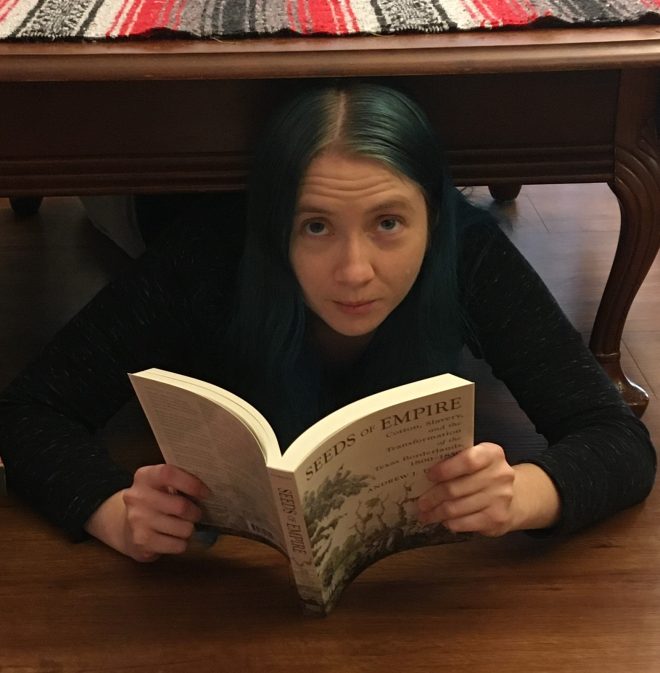
A. E. Lanier is a speculative fiction writer with stories in The Arcanist and Metastellar, among other places. She is a host for the Fantasy podcast channel at the New Books Network and lives in North Carolina with a variety of humans and cats of various sizes. She can be found at aelanier.com or Bluesky at aelanier.bsky.social.
About the Narrator
Peter Adrian Behravesh

