

PodCastle 941: Last Train from Deadwall – PART TWO of Two
Show Notes
Rated R
Last Train from Deadwall Part TWO of Two
by André Geleynse
The second time Knucklebone tried to kill himself didn’t work out any better than the first.
Sometimes, during the endless months of repair work on the endless track, Knucklebone and the other mechanical revenants amused themselves by crushing coins and other small bits of metal under the wheels of the train. Coins would fly off into the gravel bed, pancaked into paper-thin discs. Nails became miniature swords and tiny cogs spread into misshapen stars. The construction crew collected the most interesting shapes, trading them among themselves as an underground currency.
There wasn’t much that could crush a piece of hammered titanium, such as the one that housed Knucklebone’s aether core. But he was willing to bet that six-hundred tons of iron and bone just might get the job done.
The timing was the crucial part. He knew from his last attempt that he had three seconds at most between ripping the core from his body and losing all control. Three seconds to place the core on the tracks ahead of the oncoming train. And he couldn’t be too early, else one of his cohorts or an overseer would see what he was doing and rescue his core before the train even arrived.
The first thing you hear when a train approaches isn’t the earthquake rumble of its wheels, or the mournful cry of its horn. It’s a sparking in the tracks; an electric tingling, echoing along the rail like the sound of a crack snapping open through thick ocean ice. As though the rails have to brace themselves to support the oncoming behemoth.
When the first pings echoed hollowly through the arid air of the desert in which Knucklebone and his current crew were toiling, Knucklebone sidled away from the rest. He dropped the hammer he’d been using to knock new crossties into position and picked up the bolt cutters he’d conveniently left further down the track. By the time the towering black skeleton train was upon them, he was too far from the group for anyone to stop him.
This time, he knew what to cut. With the train bearing down on him, he used the bolt cutters to sever the structural wires. As the numbness began to spread through him, he took hold of his core with both hands and ripped it free for the second time. Somewhere, someone was shouting at him, but they were too far away for him to hear over the earthquake cacophony of the descending train.
Gently, like handling an egg he didn’t want cracked, he set the core on the trembling rail. Then the blackness overtook him and he fell into the ripping, screaming Void.
If anything, it was worse the second time. His soul consumed itself in an ouroboros of eternal hunger for a body it didn’t have. And this time, the inescapable thought bubbling on the surface of his liquefied, boiling brain: he was here forever. His aether must be spilled out on the desert tracks, and still he was trapped here. There was no coming back.
He was wrong, of course. The Clockwork Empire never liked to let go of a piece of its machinery, and Knucklebone had proven himself a useful cog despite his two attempts at suicide. And his core, it turned out, was practically unscathed. Scuffed by the train’s wheels, where the spinning iron had caught its edge and overwhelming pressure had attempted to squash it flat. But the core had been too strong. It had shot from the wheels like a bullet. Knucklebone’s body and core had been collected and repaired. He was sent back to work.
They’d added fifty-thousand chits to his debt.
On the streets, the laws of reality seemed to buckle under the weight of the deathly forces laying waste to the city. Knucklebone caught glimpses through gaps in the buildings: hurricanes of ghost energy; ancient remnants of lost souls given physical form by the Mothlord’s dread will. Skittering rat-forms swarming past in voracious hordes. Titans of swirling void that laid stone ramparts to waste with pulverizing blows of their gargantuan fists. The armies of the dead came in many forms, and Knucklebone did not wish to fuck with any of them.
Knucklebone knew the stories of mechanical revenants and their supernatural abilities as well as anyone. He’d heard the radio dramas: Outlaw Jim who pulled wyverns from the sky with his arcane harpoon arm, or Big Brenda who undercut the foundations of the Wizard Queen’s keep with her titanium auger. If Knucklebone were a character in one of those stories, now would be the time he revealed the ability he’d had all along — a nose like a hunting drake’s: able to track down anything he needed to find anywhere within a hundred miles.
But Knucklebone wasn’t in a radio drama. He wasn’t some prosperous princeling or robber baron who’d paid for the highest quality resurrection and top of the line exo-suit for his skeleton after death. He was a clanking, oil-guzzling heap of bolts who’d only managed to stay running this long through sheer stubbornness and several gallons of grease. If Knucklebone was going to find what he was looking for, it would be through abilities no more supernatural than determination and dumb luck.
As it turned out, the only kind of luck Knucklebone had was Bad.
He did find the factory, at least. Through the driving snow, the flashing lights of cannon fire reflected off a dozen orange vests just like his own. A crowd of Cogsmith Company employees, both living and undead, rushing away from the centre of town. Knucklebone fought his way upstream against the rush of fleeing Deadwall denizens until he found himself stepping out into an open area just off Saint Skull Street. The blocky towers of the Cogsmith Factory, their silhouette still burned into his memory from his first few weeks as a reanimated skeleton, rose before him, glowing in the snowy darkness, doors open to the wind. They hadn’t even turned the lights off before evacuating.
“Thank the Clockmaker,” Knucklebone swore.
He made it barely six steps across the slush-covered stones before an explosion somewhere to his left brought him to a juddering halt. A moment later, a humanoid skeleton tall as a three-storey watchtower slammed into the factory like an unfortunate meteorite. The bone mech was one that had been built from the bones of a long-dead giant. Its skull was twisted too far on its spine, allowing Knucklebone to see directly into its single open eye socket. A living pilot, palms skewered onto sharp bone spurs to allow them to communicate with and control the bone mech, desperately tried to regain the mech’s footing.
Concrete walls crumbled like sand under the bone mech’s twisted body. Iron girders shrieked and bent as it tried to haul itself back out of the wreckage. It managed to free one thick arm and almost stand, but it was badly damaged. Its other arm hung limp, pinned beneath a collapsed wall. Diesel poured from its engine, mixed with a glowing yellow liquid. With a thrill of shock, Knucklebone recognized it as aether.
If a bone mech was leaking aether, there were at most a few minutes before it died. Knucklebone’s core contained only six ounces, more or less. The bone mech would have exponentially more, to keep a soul that ancient bound to a body that massive, but the stuff was pouring out of it in rivulets, hissing on contact with the icy ground.
With a sound like a hailstorm hitting a tower of glass bottles, a torrent of bones wrapped in ghostly energy descended on the remains of the Cogsmith Factory. A blast of air struck Knucklebone and knocked him backwards. If he’d had lungs, the breath would have been sucked from them. For a few brief seconds, the air was cleared of flying snow, and Knucklebone had a clear view of the scene before him.
The desperately flickering light of the street lamps illuminated a writhing tower of twisted bone. Skeletons of humans, ogres, elves, giants, and goblins mixed with those of deer, dragons, camels, manticores, and a hundred others; joined to one another by viscous rotting ligaments. This ghost construct had no fixed form, engulfing everything in its path like an encroaching ooze.
Beneath its inevitable onslaught, the bone mech fired its arcane cannon once, futilely. A brief flash of searing light lit up the night. For that one horrifying moment, Knucklebone saw the shape of the ghostly abomination continuing endlessly into the blackness behind; a ravenous leviathan of incomprehensible size coming to swallow the city whole.
The bone mech’s last blast punched a flaming hole through the undulating mass, sending shards of bone raining down in a gentle patter onto the city’s sheet metal roofs. The death construct wriggled and reformed itself around the wound. The bone mech’s arm, aether dripping from its shattered elbow, wavered and collapsed. With the quiet, eerie scream of wind whistling through a thousand eye sockets, the death construct cascaded onto the Cogsmith Factory and buried it under an avalanche of death.
This, Knucklebone thought, was probably the end of his chances of ever finding his key.
“I need a drink,” he said.
It wasn’t hard to find a bar. If Deadwall was fifty percent sweaty military barracks, twenty percent gun-bristling guard towers, and twenty percent giant clockwork cathedrals to the Clockmaker, the final ten percent was entirely devoted to over-cramped drinking establishments. More bone mechs had arrived on scene at the factory, and the battle lines seemed to be holding, at least for the moment.
Since his death, Knucklebone almost never indulged in drink. Revenant-compatible alcohol was heinously expensive and eroded his parts in a way that could leave him broken and immobile on a street corner if he weren’t careful. Back when he was alive — when he was Theresa Relaric, rundown low-wage rail rat with two ex-husbands and three kids he saw once or twice a year if he was lucky — he’d often found himself hunched in the corner of a tavern or dive bar when he needed to regain some perspective. Right now, out of options and most likely about to be disassembled by a ghost vortex or stepped on by a bone mech, seemed a good time to slip into old habits while he tried to puzzle out where to go from here.
He chose a bar called “BOTS N BEERS,” which had a glowing neon stick figure of a robot in the window. Partially because it seemed to be a place that would have the types of drinks someone lacking an esophagus would be able to enjoy but mostly because the lights were still on and the door wasn’t barricaded.
He wasn’t the only patron. In one corner a trio of black-skinned human women laughed uproariously amid a smog of cigarette smoke, refilling their mugs from a keg they’d hauled up onto their table. A pale, bald man in a suit was being amorously crushed into his booth by a muscular goblin man with a bionic arm, their table of emptied wine bottles forgotten in favour of their make-out session. Not everyone, it seemed, resorted to panic in the face of death. Some would rather give in and simply enjoy their final moments.
At the bar sat a troll, wearing the same reflective orange vest Knucklebone sported. He recognized Brick at once.
“Hey,” he said, taking the stool beside theirs.
“Oh,” they said. “Fancy meeting you here.”
“Long day.”
“I’ve had worse.”
“Guess I have, too. So, what’s a dead guy gotta do to get a drink around here?”
Behind the copper bar top was a mess of broken bottles and smashed machinery. Tracks installed in the floor told Knucklebone this place had previously been staffed by automatons, but he didn’t think the shattered pile of parts scattered across the floor was going to be pouring drinks again anytime soon.
“What do you want?” Brick asked.
“Sparkling diesel, if they’ve got any. Not much else that’ll do it for me.”
Brick rummaged through the wreckage and came up with a bright yellow fuel canister not much larger than a shot glass. It fizzed menacingly when Knucklebone unscrewed the cap.
He loosened his own fuel cap, located awkwardly beneath his left scapula, and unceremoniously dumped the entire contents of the miniature can inside.
The concoction hit his system like a fuzzy electric bolt. His pneumatics went slack. His wiring pulsed and sparked. Wherever this stuff had been brewed, they made it a lot stronger than anything he’d had out on the Empire’s outskirts. He liked it. Brick saluted with their own glass and downed the dark sludge inside.
“So,” Knucklebone said. He couldn’t tell if his speech was distorted, but also, he didn’t care. “You’re not running.”
“Waiting for someone,” Brick said, voice tight. “You?”
“No point.”
“In what?”
Knucklebone waved a hand vaguely. “In . . . any of this. Life. ’S not life, really, if you’re already dead. Not where I am. Trapped forever in this fucking job. You know they won’t even let me die again? They’ve got my heart locked up like . . . like . . .” He pounded a bony fist on the copper bar top, struggling to find words. “Hey, you’re strong,” he said, as what seemed in the moment like a brilliant idea occurred to him. “Maybe you can break this thing.”
He pulled his vest wide and reached into his ribcage, fumbling blindly about in an attempt to grab his aether core. Instead, in his slightly inebriated state, he dislodged his inside pocket. The packet of letters he’d taken from the company archives spilled out across the floor.
“Fuck,” he said. And then, as if dropping the letters had broken a barricade in his brain, he was weeping.
It wasn’t possible for him to cry. None of the necessary organs had been installed. But the emotion welled up regardless.
He tried vocalizing the pain. A staticky wail like mic feedback. He couldn’t tell if it helped so he tried it again. Brick held him while he cried, and that helped too. Fuck, had he really missed physical connection this much? His body shook in their arms, the sparkling diesel working its way through his system. Coolant fluid leaked down his spine. Maybe that was what passed for tears, now.
“Hey there, bud. Okay, bud. Hey there.” Brick repeated the words like a mantra. “Let it out.”
“I have grandkids,” Knucklebone managed to choke out between wails.
“That’s great,” Brick said.
“I have grandkids and I’m going to fucking die without meeting them.”
“Ah,” Brick said. “Damn.” They patted his back some more.
For two hundred years, Knucklebone had been alone. No friends, no family, and no hope of anything beyond an eternity enslaved to a company that saw him as nothing more than an expensive hammer. But that whole time, he’d had a family out there. A family who hadn’t forgotten him, even generations later.
He’d given himself up for dead, but why? He might not have flesh or blood anymore, but he could walk and talk and cry, sort of. He was alive. He’d always been alive. And if he could keep on living, maybe someday he could even meet his great-great-great-granddaughter.
When he’d pulled himself together enough to sit up again and apologize for the coolant stain on Brick’s vest, Brick stood up and offered him their boulder-like hand.
“Come on,” they said. “Let’s get out of here.”
“Thought you were waiting for someone.”
Outside, a chorus of ghost wails underscored the crack and crumble of another building falling to ruin.
“I don’t think she’s coming,” Brick said. They, Knucklebone realized, had been crying too.
Saint Tock Station was nothing but bare bones at this point, but then, who wasn’t. Knucklebone and the other mechanical revenants had been supposed to complete construction over the next year, but somehow Knucklebone didn’t think that was happening anymore.
It was to have been a cathedral. All train stations were. What better way to express your devotion to the Clockmaker than the home of the steam engine and aether train, the hubs of a transportation network that linked every corner of the continent to the great central heart of Clock City? No one could step foot into one of the Clockmaker’s stations without feeling the thrum of her presence; the steady tick-tock-tick of the Clock, every train arriving and departing precisely on schedule in every station across the continent.
Except that this train, for the second time in twenty-four hours, refused to move.
Sickly yellow beams from the temporary work lights hanging off exposed rafters illuminated hundreds of struggling bodies pressed together on the platform, climbing up each other into the cargo cars Knucklebone had rode in on only a few hours earlier. The cars meant to carry bone mechs back to fight on the front lines of the Empire’s battles now carried half the populace of the city. Everyone who could leave another way had already left. Everyone else was here. The last train out, and their last hope to escape.
“It’s not moving,” Brick said. Knucklebone could see, even from the edge of the crowd, the small group of conductors and engineers gathered at the train’s skull. They yelled and berated, hit it with large wrenches. It wasn’t going to work.
It wasn’t going to work because Knucklebone had told the train he would free it. He’d made a promise. A promise he’d never intended to keep, and now thousands of people would die because of it.
Behind him, an unearthly wail severed the sky. If Knucklebone had had to describe it, he would’ve said it sounded like a diamond saw cutting open the skin of the universe. Everyone turned. Someone screamed.
The Mothlord loomed over the city. A black silhouette taller than a skyscraper, outlined in a faint unearthly purple glow against the midnight sky. His antennae, like dark sails, twitched and writhed like they had minds of their own. His bulbous eyes shone with the reflected light of the city aflame. He turned his head, not exactly moving but instead shifting insubstantially from one position to the next. He faced Saint Tock Station. He looked down.
For one long moment, Knucklebone felt the Mothlord’s eyes lock on his. He was overwhelmed, subsumed, drowning in absolute and utter peace.
Then six guided missiles from whatever Deadwall forces still remained slammed into the Mothlord’s torso in rapid succession, and he erupted in a tower of flame. Knucklebone fell backwards, shaking his head to clear it of whatever strange connection he’d just made.
“Right,” he muttered. “Train therapy time, let’s go.”
He dove into the crowd, fighting his way forward through the press, leaving Brick to find their own way through. This was his fault, so he had to fix it. He could feel the letter from his great-great-whatever-grand-descendant burning in his chest. A connection to the world he’d been missing for longer than he could remember existing. Surely he couldn’t die now. He hadn’t even had a chance to open the envelope.
The crowd was packed shoulder to shoulder, and pushing forward felt like trying to squeeze through a stone wall. Knucklebone kicked and punched, and was kicked and punched in return. Someone took him out by the legs and he went down, crushed under the feet of what felt like the entire city.
A stone hand grabbed him by the spine and wrenched him up. Brick hoisted him high, set him like a pet parrot on one of their massive shoulders, and began wading through the crowd like it was water.
At the locomotive, the ladder had been pulled up to stop civilians from entering the control car. Over twenty feet to the lowest catwalk, and nothing but slick sloping black steel to climb below it.
“I can get you up there fast,” Brick rumbled. “Just try to land on your feet, not your face.”
“You’re joking,” Knucklebone said. They weren’t.
They plucked Knucklebone off their shoulders, wound up for the throw, and a moment later he was soaring high, wind whistling through his eye sockets. He didn’t manage to catch himself on anything, but Brick was a good shot. Knucklebone hit the side of the train with a clatter and clang, then slid down to land in a heap on one of the lower catwalks. He thought he might have broken a bone.
Stumbling to his feet, he looked down to see Brick giving him a thumbs up. He returned the gesture with his unbroken arm, then turned to locate a ladder and make his way up to the train’s skull.
The crowd of conductors and engineers was still gathered around when he reached it.
“Who in the fuck are you?” one asked. A small man. Part goblin, Knucklebone guessed, with a slouchy hat and a puffed up aura of masculine bravado that utterly failed to hide his terror.
“I’m the guy who got the train moving last time,” Knucklebone said. “If you want to get out of here, get the fuck out of my way.”
Surprisingly, they did. They must have already tried everything else.
He approached the skull. He was babbling before his fingers even touched it, barely aware of what he was saying.
“I’m sorry,” he heard himself say. “I’m so sorry, I lied. I don’t know how to free you. I never did.”
Through the bones of his fingers, the connection roiled with hurt and confusion. A blast of steam burst from a pressure relief valve somewhere high above; a piercing wail echoing off the iron girders of Saint Tock Station. The gut-churning stab of betrayal echoed back up to Knucklebone and dropped him to his knees.
“I’m sorry,” he whispered again. “I’ve done a lot wrong in my life. I’ve been selfish. I was so focused on myself I didn’t even realize I had a family.”
There was nothing he could say to make this better. Nothing he could do to repair the damage he’d done and save these people.
“I promise if we leave; if we get out of here and we survive, I will do everything I can do free you. I’ll do anything, just please fucking move.”
A voice, soft and fluttering like the susurration of tiny wings spoke. “Curious,” it said. “Anything, you say?”
Knucklebone looked up to see a tiny white moth flutter down from the sky and land on the bones of his outstretched hand. Then a dark curtain descended over the world.
The Mothlord had arrived.
Once, scientists imagined aether was the substance that filled all space beyond the planet’s atmosphere. This, they soon realized, was false. There was nothing but vacuum beyond the atmosphere. Aether, they discovered instead, is the substance that fills the realms of the dead. As oxygen is to the living, so aether is to the dead.
It is also a substance antithetical to all life.
As the last of the bone mechs crumbled beneath the onslaught of ghosts, the last of the denizens of Deadwall crammed themselves hopelessly onto a train unable to move, and the Mothlord himself set foot on the cobblestone streets, gaseous aether billowed from the earth. Wheresoever the Mothlord rules becomes, by definition, part of the Mothlord’s halls. And the Mothlord now ruled Deadwall.
Two final missiles arced upwards. Before they could connect, the Mothlord erupted into a hundred thousand moths, allowing the missiles to pass harmlessly through and detonate on the buildings behind him. The towering figure that had a moment ago stood silhouetted against the clouds now spread, an expanding cloud of fluttering wings that blocked out the stars.
The aether followed on the Mothlord’s wings and flowed forth ahead of his horde of tiny avatars until all of Deadwall was subsumed in its yellow smog. On the platform and in the train, choked cries rose and chorused in a symphony of pain. Living tissue withered as it came into contact with aether. Anyone not yet dead found themselves struggling to breathe as oxygen vanished from the air and necrosis began to rot the skin off their bones.
Knucklebone braced himself as the roiling cloud reached for him. The Mothlord, perched on the metacarpals of his right hand, stared up at him with bulbous eyes. One way or another, Knucklebone knew, this was the end.
He succumbed to the embrace of the aether.
Knucklebone breathed. His heart beat. Warm blood flowed through his veins, and his skin prickled in a cool breeze. He opened his eyes to a world suffused with light and warmth.
He was free.
He was floating high in the sky, in a ray of golden light. He had a whole body again. Flesh and muscle and blood and organs and hair and toenails, and it was real. The past two centuries washed away, just a cold and dreary bad dream and now he was awake and alive and the world was right.
Below lay the city of Deadwall, consumed by death. Time seemed congealed, here in this golden space, as though Knucklebone was suspended in a bubble of amber. A gas tank exploded, and Knucklebone watched the shrapnel drift lazily past. The press of slowly dissolving bodies swarmed still against the unmoving corpse of the train, dying voices muffled and distant in this realm. His own body was there, too. At least, what had been his body. The skeleton puppet, animated by shoddy machinery and six ounces of necromancy that had been his prison. It lay now crumpled on the catwalk, one hand outstretched to the train’s skull.
“I’m dead,” Knucklebone said aloud, and marveled at the words, which began in his chest and vibrated up through his throat, forming themselves through larynx, lips, mouth, and tongue.
“No. You are alive. You were dead, for almost two hundred years. What is called Death in the world above is Life in my halls. You should have been with me.”
The voice was soft and whispery, fluttering like wings. Knucklebone turned to see the Mothlord. Not the towering dark behemoth over the city skyline or the little white moth clinging to his hand but a creature closer to his own size and shape, though still with a moth’s head. Its fur was silky, antennae smooth, round eyes full of compassion. Knucklebone knew, without knowing how, that he was not the only one speaking to the death god like this, in this moment. The Mothlord was everywhere, speaking to everyone.
“What has been done to you is a crime,” the Mothlord said. “You did not choose to remain in this space. You were imprisoned. Shackled by those who saw you not as a person but as a mere tool to be used. A ticking cog in their grand clockwork orrery.
“For too long has my sister kept my people from me. For too long has she turned their deaths into an unending hell. It is time for this to end. I have come to free you. All of you who should have been mine long ago.”
Joy filled Knucklebone like a warm liquor, suffusing his body from head to toe. Peace at last. Not only for him but for everyone like him. This was what he’d been seeking. He could rest at last.
Except.
There was always a catch, wasn’t there.
“What about them?” He pointed down to the train beneath their feet, to the people still piling onto it even as the air tore their bodies to shreds. The train was large; almost no one was left on the platform anymore. Brick had somehow climbed the locomotive and now knelt over a familiar skeletal figure beneath the train’s skull. Everyone still alive in the city, who hadn’t already escaped, was on this one vehicle.
“Ahh,” said the Mothlord, and his warm voice dropped into a sussurus of fluttering wings. “Well, now you have a choice.”
Cold fear began to trickle through Knucklebone’s body. “What do you mean?”
“I have no power over the living. The living cannot survive in my realm, just as the dead cannot survive in theirs. This city is mine now. It won’t be long, I think, until they join us.”
Fuck. Fuck fuck fuck. Of course this was too good to be true. This was supposed to be everything he’d wanted. The goal he’d been striving after for centuries. Why wasn’t this easy?
But Brick was counting on him to get the train moving. The only friend he had, and he was leaving them to die, along with gods only knew how many others. He may have been seeking death, but they weren’t.
“Can’t you just let them go? Make the train move?”
“You would ask me to bind one under my care back into the shackles of the enemy?”
The Mothlord gestured with one long-tendriled limb. Knucklebone saw, in this golden new world, a dinosaur galloping through the air over the ruins of the Cogsmith Factory. A long-necked herbivore, huge heavy feet pumping the air as it raced circles in the sky, revelling in the sheer joy of wearing its own body again.
“I kept the promise you could not,” the Mothlord whispered. “Do you wish me to break it?”
“Of course not,” Knucklebone muttered.
There was one option he could think of. The train’s soul had been freed, but its aether core remained. What Knucklebone was thinking shouldn’t be possible. But he was here, speaking to a god. Surely if anyone could manage it, it was the Mothlord.
But gods, Knucklebone didn’t want to suggest it. Everything he’d wanted for so long was here in his grasp. He finally had his rest, and he was just going to throw it away? For what? For a rock troll whose shoulder he’d cried on one time? For a family so many generations removed they may as well not even be related? For a train full of people he’d never met or cared for?
Yes, he realized. That was exactly what he was going to do. He wanted Brick to live. And the rest of the people on the train didn’t deserve this death, probably. And more importantly, somewhere out there he had a granddaughter. He would never meet her, he knew that. And though it made no logical sense, he couldn’t bear the thought of being the type of person she couldn’t be proud of.
Knucklebone looked up and met the Mothlord’s massive, shining eyes. The god already knew what Knucklebone was going to choose. Knucklebone was pretty sure he’d known from the beginning. A trade: one soul for another. He’d keep his promise after all. He nodded, and the Mothlord nodded back.
“Can I ask one favour first?” Knucklebone said.
“You can always ask.”
“Let Brick know what happened to me. Maybe they’ll find my family, and can tell them . . . I don’t know. Give them some closure.”
The Mothlord bowed his head. “Done,” he said.
The golden light vanished.
The third time Knucklebone tried to kill himself, he changed his mind.
Smoke billowed across the arctic plain, trailing the train headed North. In the distance behind, the city that had once been Deadwall shimmered like a dark mirage. It was part of the Mothlord’s halls, now, and no longer existed in the mortal realm.
Inside the train rode six-thousand eight-hundred and twelve souls; the last survivors of the city’s destruction.
On the front of the train was a skull. And below the skull was the skeleton of a man who had been dead for a long time. It lay tangled up in a jumble of machinery, wires, and an impressively shitty diesel engine. The engine no longer chugged, and frost coated the metal.
Brick knelt down. Gently, they lay the skeleton out on its back. From its ribcage they pulled a packet of letters.
They sat down on the catwalk and leaned back against the forward railing, letting the wind buffet them as it would.
“Thought you might like some company,” they said, addressing the skull on the front of the train. “I know you can’t talk yet. I’ll get them to install some speakers later so you can swear at me all you like. You know, as a thank you for saving my life and all.”
They pulled one of the letters out of the bag and carefully opened the envelope. “In the meantime, I’ll help you catch up on your mail.”
Host Commentary
…aaaaand welcome back. That was “Last Train from Deadwall” by André Geleynse, who hasn’t been on an Escape Artists cast before! But who does have a website at andregeleynse.com with links to his other published stories in venues like Heartlines Spec, Small Wonders, Hexagon and more.
On today’s story, André writes: This story was born a few weeks after my daughter was; written largely between 10PMs and 2AMs with her asleep on my chest while I tried to give my wife a few hours of rest before we’d switch places. As with most of my stories, it originally came about by me smashing together various concepts I enjoy (dinosaurs? trains? skeletons? gods?) and seeing what happens.
Of course, what happened is a lot of things that are far more relevant to our world today than I wish they were. The capitalist destruction of the world’s ecosystems, appropriation of our labour, and policing of our bodies. The powerlessness of living under regimes of rulers who wage wars you never asked for, who display only contempt for those they are meant to serve.
But even in the face of what seems inevitable, there is always something we can do, however small. As Ursula K Le Guin said, about living in capitalism: “Any human power can be resisted and changed by human beings.” So resist. Protect trans kids. Protect immigrants. Fight for the liberation of all people.
Thank you, André, for those thoughts, and the story that grew from them. It will surprise you not at all, I suspect, to learn that I am here All Fucking Day for these themes. Capitalism literally working us down to the bone? Locking us in servitude and building walls to keep us from our peace and rest? Sounds about fucking right, yeah.
It’s almost funny how they’re shilling generative AI to us right now. Computers were sold with a promise of increased efficiency, greater productivity, and thus more leisure time to do the things we really wanted—read, write, paint, create. That never came to pass, of course: one set of figures I found, from the Economic Policy Institute, quoted an increase in productivity between 1979 and 2025 of 92.4%.
We should be able to complete a 40 hour work week in 21 hours! We should all have our afternoons for ourselves, or have 4 day weekends! But instead we are pushed just as hard as ever, if not more so, and don’t see the fruit of those labours in either time nor money—hourly pay, in that same period, only grew 33%, with the difference going into either executive pay or shareholder pockets, i.e. the capitalists growing more… capitally in a virtuous cycle, at least from their perspective. To the rest of us it’s just a howling tornado, tearing at the foundations of everything that binds us.
And now they’re not even pretending AI, as the new boondoggle, will do anything for us at all. Its benefits are pitched entirely at that capitalist class: get more work out of fewer people; cut out those awkward, inconvenient humans with things like “personal circumstances” and “opinions on fair recompense for the value of their labour” and, heavens forbid, “unions”.
You won’t even need humans to do the tricksy work of creativity anymore: we can replace it all, wholesale, with thinking rocks, that even get first dibs on the drinking water. The humans just become cogs in the machine, the necessary physical presence, the algorithmic avatar delivering your tchotchkes and trinkets in a prescribed path that neglects to account for such human inconveniences as “bathroom breaks”.
It is surprising, when you stop to consider all this, how much these actions feel like loathing. Capitalism, as a system, has developed a deep and pervasive disgust for humans. We are inconvenient and messy and independent and unpredictable. It seems to be doing its very best to do away with us all together.
And you have to wonder… why? Why do we accept this? Why do we deify GDP and national deficits as if they are the most important consideration of all, gods to be appeased, to whom we sacrifice so much? We will withdraw benefits from the disabled and leave them to die; we will withdraw funding from children’s centres and special education; we will, almost without asking and with an eagerness that is deeply worrying, sacrifice arts and culture programmes to instead save the money, as if they are not the very thing we should be living for, that elevate our existences from mere survival to something worthwhile.
If we’re not, as a society, willing to spend our money on kids and whatever they need, what the fuck are we saving it for?
When did we go from capitalism serving us, to the other way round?
(That’s a rhetorical question, by the way, you and I both know the answer is “Reagan and Thatcher”.)
Not a one of us can escape the system alone. Best any of us can do as individuals is navigate it, such that we become a beneficiary rather than a victim, which is effectively climbing on everyone else’s heads to escape the floodwater drowning us all. That’s not escaping the system, that’s just exploiting it, and in doing so further embedding it.
The only way to escape it is to escape it together. To work together, and treat each other honestly and respectfully, to pull together till that weight can no longer be resisted. Maybe there was a path where the system could have acted with more moderation, more respect, more consideration, and been sustainable and sufferable: but it turned away from that a long time ago. I worry now that the only way to escape capitalism will be to pull it all apart, because as necessary as that is starting to feel it will still be painful, will still hurt so many, for it won’t go down without a fight.
But the longer we wait, the deeper its roots grow and the higher its canopy, stealing more and more sunlight from above us, taking more and more water from below us. It is starving us of everything it means to be human, and soon we won’t have the strength or the means to resist it. Any pretence the system held onto has been dropped, and the greed and exploitation are now openly boasted about. Even the Romans understood the need for bread and circuses: but gods forbid someone on benefits ever eat something enjoyable, or go to a gig or something, lest the wrath of the Daily Mail descend upon their unworthy brows.
But the problem is: I’m just so very tired. Can you guess what exhausts me so much I have nothing left to give for the fight?
Exactly.
About the Author
André Geleynse
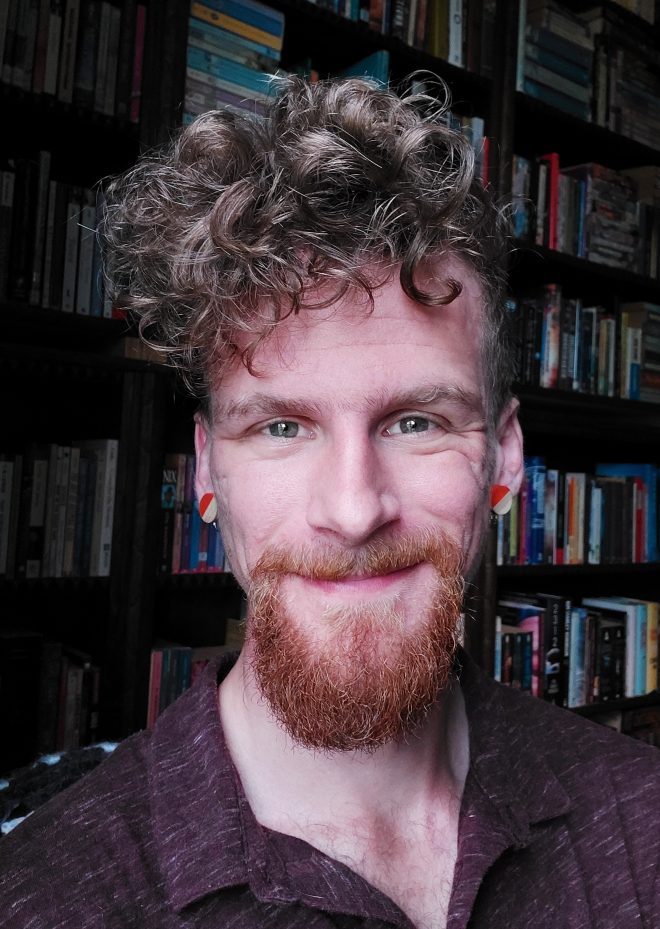
André Geleynse is a writer, aspiring homesteader, and architectural technologist from unceded Algonquin Anishinaabeg territory near Ottawa, Ontario. He lives with his family and his animals, including dogs, cats, horses, chickens, goats, and a snake. André is an editor and Managing Director for Augur and Tales & Feathers magazines. His fiction has appeared in Beneath Ceaseless Skies, Heartlines, Small Wonders, Haven Spec, and more. Follow him on Bluesky @andregeleynse.com, Instagram @alisterscriven, or visit his website www.andregeleynse.com.
About the Narrator
Rae Lundberg

Rae Lundberg is a writer and voice actor from Kentucky. In addition to co-writing and acting for The Night Post, Rae is also the showrunner and sound designer. Their writing and sound design work can be heard in Nine to Midnight and KILL FM, and they have lent their voice to dozens of audio drama podcasts. Rae lives in the SF Bay Area with their wife, three cats, and overflowing shelves of queer books. You can find more of their work at heyraeva.carrd.co.
