

PodCastle 937: Kɛrozin Lamp Kurfi
Show Notes
Rated PG
Kɛrozin Lamp Kurfi
by Victor Forna
Breath
KADE MAKASI: In . . .
ALL THE CHILDREN: Awt . . .
Storyteller
She tells the children to call her Kade Makasi, and if this was one of her stories, she’d describe herself as bent and wrinkled and spider-like for a touch of myth and poetry . . . but she’s none of these things . . . she’s tall, thick-browed, with two braided rivers of night on her head, and you’d have never guessed what she was: kurfi, dɛbul, demon, and that she stole my child.
Stolen
Moon beams from Madina’s sky. The kurfi narrates to the bright stares around her fire. To Kori, Takere, Mbalu, Ruba, Yulai, and Mar. She says: There once lived a beggar-boy called Kari, see him in tatters on the street of a city at the edge of the world where all the houses loom breath to breath, eye to eye.
And, there he is . . .
Peer into Kade Makasi’s story, into her flames, at the face of Kari the beggar-boy, and you’ll find the face of my son who went missing nine days ago, whom she stole off the road on his way from the luma in Gbinti.
Kari was eleven years old, with a head like a mango seed, and large, brown eyes. Kade Makasi describes without love, but I know that’s my boy cuddled on the wayside, in the rain, in her story, starving and cold. I watch her fire from behind banana groves.
She continues: One night, from an alley came a man. Walking-stick in grasp and no care for the pelting rain. He marched towards the beggar-boy. Wordless, he offered him his hand . . .
Magic
Granny told me stories when I was a girl. She told them to me in the way of our ancestors, teaching me the old tongue Yeliba. I’m not much of a storyteller, only a mother out to save her son, and with the magical language, I etch myself into Kade Makasi’s tale: But there was a woman beside the beggar-boy. Short, thin. She punched the man in the nose. He doubled over in pain. She tugged Kari away from him, and they dashed into the night.
Disappeared from the real world, I crash into her plot.
My presence slows her. Everything about her story must be changed to accommodate me.
But this is only a small victory.
We’re still trapped in her world, tethered to her words.
Kade Makasi counters: And the man and his three dogs followed the woman and the boy fleeing into darkness. He’s a hunter and a magician from one of the villages on the outskirts of the city at the edge of the world, his name Yarabi Tafaikɔ. Angry, trembling, nose flaring — the beggar-boy had stolen a thing dear to his heart.
Cage
Changes made in the middle of a story — there are always consequences for them. Plot holes begin to form around us, rifts into the real world.
Peer into Kade Makasi’s story, and you’ll see us sprinting, a stranger and a beggar-boy, mother and son, hand in hand. We run between the finger-apart houses, searching for plot holes and freedom. We enter alleyways that lead to dead ends, sentences beyond them yet to be born.
I spot a plot hole beside a lonesome church: sizzling, white pit hovering in midair . . .
As we dash toward the hole, the kurfi introduces pillars to uphold her tale, imbuing sense to her narrative. What thing dear to the man’s heart did the boy steal? Why was it dear to his heart? Why did the boy steal it? She asks, she answers, closing every open end brought about by her changes, on and on.
Before we get to leap into the plot hole by the ruined church, it disappears with a hiss.
The Hunter and the Lion Skin Thief.
The story was no longer for entertainment alone.
A story can also be a cage.
The Hunter and the Lion Skin Thief
Yarabi’s wife, Yeni, was dying.
“I don’t want to die,” she blurted out. On a mata outside their home, her head on Yarabi’s chest, their eyes naming the stars.
“There’s so much we planned to do. Wanted to see the world with you. We were going to go to Qhore, those sphere cities. I can’t even walk myself to the outhouse.”
“You aren’t going to die. I’ll find a way.”
After Yeni went to sleep, he brought out his calabash and mirrors to look for answers in the ground, in the distance inwards. First, it gave him silence, because he’d been away so long. So he spilled his blood into its mouth and the ground said, “Your wife will die, Yarabi who once turned himself into dust, unless you give her the skin of a raven-black lion.”
In the forest behind the city at the edge of the world, Yarabi found the cave and entered it.
The night-skin lion was before him. It growled. Magic in its eyes; no irises, only lightning.
“Forgive me,” Yarabi said.
The lion sprang at him — but he became dust. Using the gifts he learned in boyhood, he scattered himself into his seven dogs.
In their bodies, he charged at the creature. Scratches. Snaps. Bites. Barks. Roars.
Until twilight came.
Four dogs died in the end, but the lion had been killed: wounded on its side, inky blood.
The dogs flayed the skin from the dead creature and placed it in a bag.
And they went outside the cave, moaning for their cuts and pains.
The magic demanded a moment of stillness as Yarabi’s pieces moved out of his pets to reform himself again. And it was at that moment, when the dogs in the shadows couldn’t move, mist rising from their furs, that Kari the beggar-boy, strolling the forest, came upon the raffia bag with the lion skin.
He took it, sprinting off through the trees. Maybe the boy hoped the bag contained gold and silver, or something he could sell to buy bread come morning.
And Yarabi watched it all, and there was nothing he could do, his heart breaking.
Sokolokobankɔsi
I push the story on, hoping other plot holes form nearby . . . but even in this . . . I can’t stray too far from the previous tone and setting. Stray too far, and that’s how you lose your mind. I say: The boy held the woman close. Who was she to him? Could angels come to Earth in the garments of beggars and forgotten things? They’d lost their pursuer in the mist and maze of the cityscape. In the distance: an old inn, with a lamp lit over its door. In its arms, they’d rest awhile, stay the night.
But the Storyteller lays obstacles every step of our way: However, stopping was a bad idea. For one, the man and his dogs were closing in, following the scent of the duo. Two, and most pressing, you see; the inn was nothing as it seemed — the inn belonged to the witch with three eyes, Sokolokobankɔsi, guised as an old man, bald-headed, toothless, frail. “All the upstairs rooms, filled. Downstairs, free.”
Outside, the rain roared.
My Luseni doesn’t know he is in a story; he yawns only because Kade Makasi wills it; he pulls me along the narrow staircase to further her tale . . .
She says: Sokolokobankɔsi blew ashes in the woman’s face. She tumbled down the stairs.
I want to counter her words. I hesitate. Every time I use the language of the Yeliba, death closes in on me.
I can’t die with my son still stuck here. When I regain consciousness, I search for plot holes around the paper thin Sokolokobankɔsi.
There are few around him, small white dots, swirling, nothing big enough.
Kade Makasi goes on: “Why are you here? Come to steal my my . . .” growled the witch, disguise ditched, revealing his third eye on his chin. “I smell it on you, your thievery. So many people . . .”
The woman, hands and feet tied, was on a boat in a sea of darkness. You couldn’t tell the waters from the skies. The witch slashed her cheek with his knife when she failed to answer him. Blood dripping. Wince, grimace. “Where’s the kid?” she asked.
“That coward. He fled.”
“Where are we?”
“Where you die if you don’t give me what I want. Who sent you?”
The Storyteller paints my son a coward, but I know how brave he is, I know how much he’s faced for being born different. She adds: Another slash. “Thief,” said Sokolokobankɔsi, his third eye blinking. He mumbles to himself, “No, no, I am not paranoid!”
“She’s going to have me do this until you tell yourself out of the story, you know?” says Sokolokobankɔsi, but it isn’t dialogue given by Kade Makasi. “She won’t kill you because she knows you’ll come back. Torture, however . . .”
“You know you’re in a story?”
“Oh, I’ve been hostage here long enough. I’ve been hero, I’ve been villain, I’ve been brave, I’ve been the epitome of cowardice. And I learnt a few tricks in between. There’s a part of all of us down here that knows we act without free will, but it takes a while to understand what we’ve become, like in dreams. I know we are characters in a story. And I know your boy is doomed. Or is it your presence that makes me hear that distant whisper?”
“Shouldn’t this cause a plothole?”
“I remember the answer why it doesn’t, but I have forgotten how to say it.”
The Storyteller says: . . . he yanked out the woman’s nail. A scream so loud it shook the black.
“There must be a way out,” I say as my pain subsides.
“Never seen it happen. You’re not the first to come in here. Others have entered her worlds before, looking for loved ones. She either tortured them until they left . . . or you know what happens every time you use the language. And our little deaths add up. Leave the kid.”
“I can’t . . .”
“A mother’s love is stubborn. I was a father once, I think. So I understand, I think. You know she was trapped, and he freed her?”
“What?”
“Your son bought the lamp that had been her prison for almost a hundred years from a wanderer at the luma in Gbinti. Removed the shade, and wanted to clean it before he got home. And —” He makes a gesture with his fingers, mimicking appearance, the rise of something from nothing.
“My son freed her, and she imprisoned him? I’ll do all I can to save him. If I can’t in the end, I’ll stay in Kade Makasi’s worlds, disrupting every plot she thinks up until she lets us go.”
“No, until you die. Or worse — the oldest ones. They are even more wicked than our captor. They’ve been here since the beginning of time. Since the storyteller said the first in. They’d rather be captives in stories than in perpetual silence. They have nowhere else to go. Be in the shape of stories long enough and you lose everything real about you. If Kade Makasi completes her telling, she’ll have days or even weeks to find a new audience. With an incomplete story inside of her, in just hours she’ll be returned to her lamp. The longer you are here, slowing down the tale, the greater the chance that she’ll be unable to complete. If they get to you. What power will you have, say, with a severed tongue? You will be trapped in here forever. Run while you can.”
“Whatever comes . . .”
“A mother’s fucking love!”
“And if all fails —”
“No . . . that . . . you wouldn’t.”
Bubu Dancer
When I gave birth to Luseni, sweat still on my face, my mother and mother-in-law loomed over me and told me then, as the witch with three eyes tells me now, that I should leave my son. They told me if he latched on to my breasts, he’d suck more than milk out of me. He was not meant for this world, look at the shape of his head, look at how small he is, you know the stories, we must throw him into Nomse Forest. I told my mothers I’d rather die. I screamed in their faces. I fought for him then, as I fight for him now. The past eleven years have been rough, but no one smiles as my baby does. You should see him dance when bubu plays. These little things — a child’s smile, the way he twirls to music, the ring of his laugh, the sillies he does to cheer you up when you’re down, the leap in your heart when he returns home with the setting sun — are how you know the fight is worth every kick and blow. The ones you take. The ones you give.
Stubborn
The Storyteller says: Another wail rose from the throat of the woman.
“Stubborn. I feel for you. But this will go on and on, stranger. Tell yourself out of the story. Leave the kid.”
I take a deep breath. “No . . . but I can’t stay in this scene forever.”
“So, what next?”
“I will bring the hunter,” I tell Sokolokobankɔsi. “He seems the type who’d save me, and we’d both go looking for my son.”
The language hurts, slow death of me. I grunt my counter story: Sokolokobankɔsi startled, dropping his knife into the colourless waves.
Barks. Recital of mystic chants.
“Better him whose motivations are clear, than this three-eyed emptiness made to believe my character is here to steal from him. Kade Makasi sketches Tafaikɔ a hero, a romantic; I’ll use her ideas against her.”
I add: Yarabi Tafaikɔ entered the black.
Kɛrozin Lamp Kurfi
TAKERE (Aside, to Mar.): I think we should go home. The story keeps . . . she’s taking too long.
KADE MAKASI: What you talking?
MAR: Let’s continue tomorrow.
KADE MAKASI: No!
TAKERE: A friend of ours went missing. Our parents will be worried if we stay out late.
KORI: Luseni ran away. There’s nothing out to get us.
YULAI: No, he didn’t. That’s not him. He was odd upstairs, but he was a good kid. I agree with Takere, I’m going home.
KADE MAKASI: I must complete —
(Yulai, Mar, Takere standing to leave.)
YULAI: Come on, Kori.
(Kori, Mbalu, Ruba standing to leave.)
KADE MAKASI (Muttering to herself.): No, no, no. This is your fault, woman. The storyteller can hold characters captive while the story holds the audience. I have done no wrong. Get out. I need him, I need them. Muse. Aftertaste. And what better way to keep the children of Madina invested in my telling than having someone they know inside of it? All good stories need heart.
MAR: Thank you for today. We will look for you again tomorrow . . .
KADE MAKASI (Chasing the children): Wait! Don’t you want to know how the story ends? Wait! Don’t go, don’t leave. Don’t you want to know if Yarabi Tafaikɔ will get the skin and save her wife? Her? His? What will happen to the thief Kari and his mystery saviour? Why is she helping him? Please, wait. I need to tell stories, it is the only way I can be free . . . wait . . . the birds in the trees will not be enough, nor the stars above. If you listen to this one, I’ll tell you about Lɔri Yabas, or about Amadu Fi and the Mami Wata that gave us bubu music, or about Payk and the Thɛbu, or about the conjoined twins of Nomse Forest, or — or about my father Raka Makasi the sokobana and how he made me a prisoner to stories. (Crying, going up to each child, shaking them by their shoulders) Don’t leave me here. If only I could rid myself of these things! Okay. Okay. I will tell you the story as fast as I can. Listen, listen. Yarabi Tafaikɔ entered the black. Sokolokobankɔsi charged at him. They fought on top of water, like gods, unsinking, casting juju and punches. “I’m not here to steal from you!” said the hunter to the witch with three eyes.
(All the Children run home, never looking back at the slumped figure on the ground.)
KADE MAKASI: And then and then —
Vestibule Between Worlds, or Silence
Like death.
All goes white, and the silence around us has thorns.
Setting fades away. Continents, cities, fields, forests, wildernesses.
A dream in twilight: suddenly, we’re all in a giant vestibule.
Peer into Kade Makasi’s silence, into all that’s left of her fire, and you’ll find her characters choked in a foggy, purple hallway, nomoli made of flesh.
“Hurry!” Their voices echo, water into water inside a quiet cave. Sokolokobankɔsi and my son. They call for me, pointing at the band struggling my way from the other end . . . the oldest ones . . . those who’d rather stay in cages . . . as long as their locks cast phantom meaning on them and give them illusory destinies.
Although the characters they’d been in “The Hunter and the Lion Skin Thief” are vestiges on their emaciated bodies, ageing paint on a wooden mask, I can still tell who the leaders of the cluster worming toward me are.
Yarabi and Yeni, in the dim light of the vestibule between worlds.
They close in on me.
Weaving through the still figurines feels suffocating, like swimming through oil.
My heart thumps.
Is this how it ends?
I turn around. In the distance, the drooping face of Yeni, her eyes orbs of sapphire and wickedness.
I hurry on.
Beside a nomoli with a beard that has no end in sight, I catch up with Sokolokobankɔsi and my boy. I hug Luseni.
He smiles, tears on his cheeks.
What loneliness has he seen?
What pain, my little boy?
All bones. “Mama, you’re here.”
“Always.”
Sokolokobankɔsi cuts. “No time . . . come.”
“Why are you helping us?”
“You know . . .”
He runs on; we follow.
We’re out of the hall.
Wet grass beneath our feet, dusk above. A lake rises before us; beyond it lays night alone. Sokolokobankɔsi pushes Luseni into . . .
“What’re you doing? He can’t swim!”
“Hiding. Until you can figure out how to end this. Plus, the Oldest Ones can’t get in here. And have you forgotten?” He shoves me, too. “We can fly if you give us wings.”
As the lake shatters into infinite emerald droplets against my body, I whisper: They could breathe and talk in water.
Lake
Rainbow-coloured fish swim among the purple rays from above; sharks; dolphins; colossal bioluminescent octopus glides from us and our bubbles; mermaids gather in their corners, golden combs in their afros; sunken statues, soapstone nomoli; boys; girls; the old, too; sunken boats and sunken ships; sunken cities, blinking lights on towers: all in the lake.
Selfish/Selfless
“This is the only way,” I say to the witch.
“No,” he says. “You could let your son go. Return home. Mourn him with your family. He’s okay with that, he is.”
Luseni’s brows curve downwards, but he nods his agreement.
“How could I mourn him knowing he’s alive in stories?”
“Everyone we mourn is alive in stories.”
“You know what I mean.”
“What you want to do is selfish. It will work, yes; bringing Kade Makasi into the story world would break it apart, implode the entire fabric of her universe.”
“I’ll lose my own mind, too . . . starting a whole new story.”
“We all will.”
“But Luseni will be okay. He hasn’t been in here that long. I’m willing to make that sacrifice.”
“What about the others?”
“I don’t have much time. I wasn’t going to do it. No one wants to destroy a storyteller. But all my life I’ve fought to give my boy a chance. Obstacle after obstacle. His father’s death. The bullying. I was always there for him. All my farm work. All my hawking. You sacrifice for your kid to live, you know? How can I stop now? His siblings will take care of him when he goes back.”
“I was the last person to hinder Kade Makasi’s story, returning her to her prison. I’ve forgotten Yeliba now, fickle language. Your presence and power reminded me a bit of it, I think. Which is why I could speak to you in the story. The Oldest Ones killed the wife I came in here to save, to take back to our children, and I became trapped with them. The memories are dim — am I even sure if they are true? — I’ve always wanted to see this place burn, but as lonely as it has been, there are people here who deserve better, people who need these stories to breathe. Break it apart and we will all return mad to the real world, roaming streets we walked so long ago.”
“What am I supposed to do?”
“I just want to go home . . .” Luseni’s never been one for words, my beautiful boy. “Stories hurt . . . even the happy ones. I want to be free. I want to go home, Mama . . .”
I look at Sokolokobankɔsi. In the water, he seems like a ghost with wispy, shimmering edges.
“I will be your audience. Take us home. Tell us a story.”
Freedom
In the language of the Yeliba, I start a story of my own: In, I say in the lake.
“Awt,” Luseni and the witch, together.
Always begin a tale with breath — stories are living things held between the teller and her audience.
I go on: She tells the children to call her Kade Makasi. . . A ball of blue light begins to flicker in a corner of the lake, growing, growing . . . she’s tall, thick-browed, with two braided rivers of night on her head, and you’d have never guessed what she was, tiro black on her eyes: kurfi, dɛbul, demon.
And, there she is.
Peer into my story, into the lake, and you’ll find Kade Makasi there, afloat. She tries to scream, to undo my narrative, mouth wide open, but water fills her lungs.
First, a quake. Then, the implosion.
The nomoli above, along with the Oldest Ones, are sucked into the lake, into the vortex Kade Makasi becomes.
Animals from the night beyond.
Fish.
Mermaids.
Stars.
Comets.
Us.
Everything swirls into everything.
In the whirlpool: a woman rests in dust, exhausted, lost. She babbles to herself . . . and she has my face. Luseni brings her cassava and stew every evening, and kisses her forehead, his friends Takere and Yulai by his side, and when they ask him how she brought him back, where had he been, how did she lose her mind . . . he answers, almost weeping, we’re all found in stories if we look deep down . . .
Yarabi and Yeni . . . what happens to our unfinished tales when we die?
A man roams a backroad far away from Madina. He calls himself Sokolokobankɔsi. He knows no one. He has no one. He calls himself a thousand things. There are hundreds like him, with no north star, with no true name. Are those smiles on their pale faces?
My boy dances bubu.
I watch him dance and dance.
I see it all in the whirlpool, colours ever changing.
A story can also be freedom.
Fragile
Ends are fragile things.
Broken shade of a kɛrozin lamp . . . blood on its shards.
How to end stories that begin with breath: in, awt?
A promise to always return to and for each other; stori go, stori kam.
Host Commentary
…aaaaand welcome back. That was “Kɛrozin Lamp Kurfi” by Victor Forna, and if you enjoyed that then dig your way back through our archives to episode 769, “In the Woods Somewhere (or, Stories Never Leave)”. There’s a handy-dandy list of his other publications on a Linktree, too, linktr.ee/vforna, for plenty more reading
It should not be a surprise that we, who have spent years in this castle for the love of the thing, believe in the power of stories. That EA tagline of one story, told well is a mission statement, too, and one we actually think about and hew to: we wouldn’t have spent over a year trying to get this one right if we didn’t think it was important to tell it right.
Stories are what define us as human. The oldest evidence we have of “humanity” is often the art that tells a story, even be it the story of a hunt captured in paint and ashes on a cave wall. We, as individuals, are narrative threaded through a collection of memories we retell ourselves over and over—literally, with memories rewritten every time we recall them. People will end up with different interpretations of the same event as we each endeavour to rationalise our experiences with narrative, often recasting ourselves as hero or victim out of fear that the wrong story and the dissonance against our pre-existing self-narratives will do actual emotional damage; and we deify this cause-and-effect we crave so much as fate and destiny.
We decide justice and truth through storytelling in courts, with appeals to an audience who then vote on the narrative they find the most compelling explanation. As society, we are a loose conglomeration of often conflicting stories: national myths, visions for the future, cause-and-effect.
My great frustration of the last ten or fifteen years has been that liberal politicians have repeatedly belaboured under the belief that policy will win the day, while conservatives and fascists have made great ground by selling people stories: that immigrants are to blame, the welfare state is to blame, environmentalism is to blame… and never mind that these narratives have gaping holes in them that split open after mere seconds of scrutiny, because stories are so compelling that people often just accept them without question.
And now we are all trapped in those stories, witnessing the dissonance of those easy narratives versus the complex realities manifest as misery, hatred, blame, and violence: rising prices and falling employment, a melting planet and literal war… all of which, of course, is begging for further narratives, which the usual suspects will be only too happy to supply.
Stories are powerful. Stories are the inherent structure of being human, the heart of all our experiences and our very selves. Given how integral they are, they hold outsized power over our thinking, and so they should be used responsibly: but there’ll always be those who only care about themselves, who will—to use a timely example—sell narratives of masculinity and anti-feminism they don’t even believe just so they can turn a profit in money or attention. There is, I fear, little you can ever do to stop such selfishness from existing.
But stories can also be vaccines. The right stories told at the right time will immunize you to the lies that might follow: we all know the importance of getting your side of the story across first, right? Because that sets the context against which other stories are judged. So we need to keep finding compelling ways to tell our stories, and ways to get them out there, and ways to say the truth matters and kindness matters and it is possible for tomorrow to be better than yesterday. We need to see the power of stories and not surrender to them, but wield that power, and use stories to shepherd the world to a better place: a place where children matter more than balance sheets, where the common good can no longer be stolen for the benefit of the few, where kindness is its own end and a rising tide to lift all boats.
About the Author
Victor Forna

Victor Forna is a Sierra Leonean writer based in his country’s capital city Freetown. His short fiction and poetry have been published in Fantasy Magazine, PodCastle, Lightspeed Magazine, Strange Horizons, Nightmare Magazine, Apex Magazine, and elsewhere. He is an alumnus of the 2022 AKO Caine Prize Writing Workshop.
About the Narrators
Soila Kenya
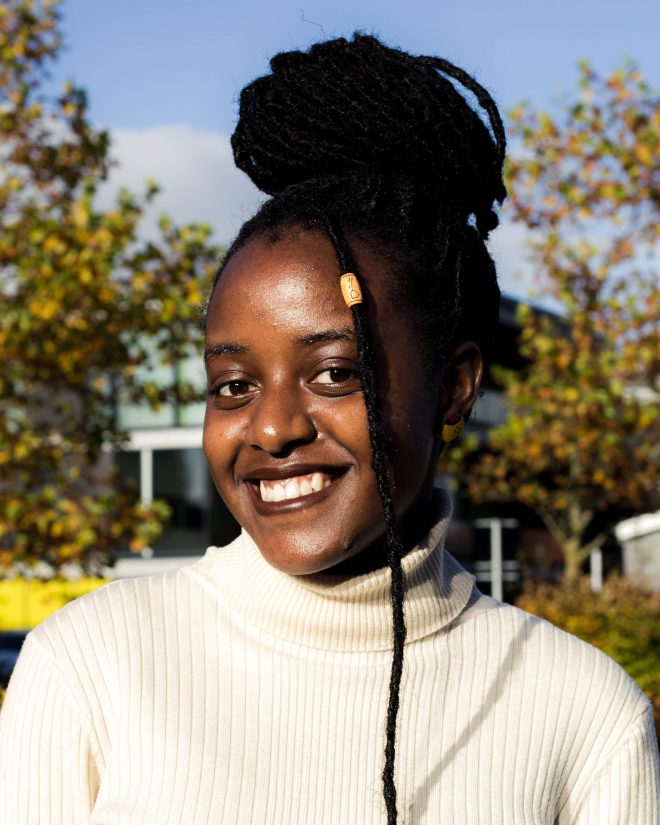
Soila Kenya is an Africanfuturist womanist award-winning data journalist from Kenya. She is an enthusiastic reader of African SFF and the curator of @africansffhype on X and Bluesky. Find her at soilakenya.com.
Opie Ogundiran

Opie is a lover of interesting stories. When she’s not reading, she’s usually looking for other ways to satisfy her artistic cravings.
Tahnia Barrie

Tahnia Barrie is a Sierra Leonean poet and writer, currently based in her country’s capital city, Freetown. She is a 2024 Voodoonauts fellow, an alum of the 2023 WAW residency at the Library of Africa and the African Diaspora, and an Associate Editor at PodCastle magazine. Her work has been published or is forthcoming in the Commonwealth Foundation’s literary magazine adda, Strange Horizons, Lolwe, Fantasy Magazine, 20.35 Africa’s Anthology of Contemporary Poetry and elsewhere.
Munashe R. Goromonzi

Munashe Rachel Goromonzi is a Zimbabwean based theatre educator, NAMA award winning screen actor and an upcoming director. She has works across the screens and stages of Zimbabwe and Africa. Munashe holds a BA in Applied Media and Performance Studies.
Wanini Kimemiah
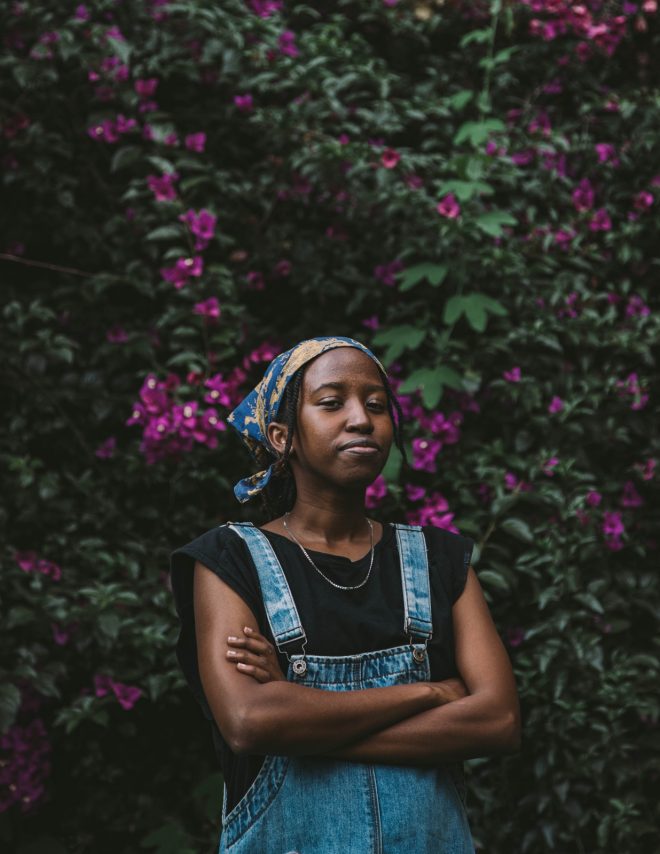
Wanini Kimemiah is a writer, visual artist and archive maker born and based in Nairobi, Kenya. Their artistic practice is a research and process-based exploration of the idea of the sensorium. Using a variety of media as sensorial tools that range from writing, painting, collage, lens-based media, textile-based media and alternative processes in cyanotypes, they cultivate an ecology of existence that pulls back human attention from the distractions and disconnects of anthropocentricism to the instinctive interconnectedness with the worlds which we belong to. They were the inaugural fellow for the Stedelijk × Contemporary And Editorial Fellowship 2023/2024.
Shingai Njeri Kagunda

Shingai Njeri Kagunda is an Afrofuturist freedom dreamer, Swahili sea lover, and Femme Storyteller among other things, hailing from Nairobi, Kenya. Shingai’s short story “Holding Onto Water” was longlisted for the Nommo Awards 2020 & her flash fiction “Remember Tomorrow in Seasons” was shortlisted for the Fractured Lit Prize 2020. Her novella “And This is How to Stay Alive” won the Ignyte Award in 2022. She is also the co-founder of Voodoonauts: an afrofuturist workshop for black writers.
