

PodCastle 936: Ananconfabulation
Show Notes
Rated G
Ananconfabulation
by Mar Vincent
Our homes are buried, so we built tunnels. From Tomas’ window to mine, from Ryan’s to Kimber’s and back to Tomas’ attached garage where it has little windows up high in the door. A rabbit’s warren of passages just wide enough for our juvenile bodies.
I remember the day it happened. Opening curtains and seeing the sun, the trees, the clouds. Opening them again, only a few hours later, and seeing nothing but solid gray against the glass. Time keeps moving the cat clock on my wall and the appliances in our kitchens tick forward, but is it day or night or real at all? I don’t trust that time is what it used to be.
The TV stopped working, and the internet, even the radio, so all we could do was guess what had happened. Was the whole world buried, or just the neighborhood around us?
Tomas lived next door, so that tunnel was the easiest. The first place I thought to go. Both of us started digging through from our own sides as though we’d planned it (we hadn’t), and shouting for each other when we got closer (like we sensed it) until we lined up the tunnels to connect. Light came in from his side, through the ashy-concrete stuff that made the walls (that made the world), and then his fingers poked through, and I wasn’t alone anymore.
We talk about before less and less even as the clocks pursue the nonsense of time. Think less about the people who should be coming for us because if they haven’t by now (after weeks? Months?) it must mean they can’t. We’d all come home from school that day but, before any of our parents arrived home, everything changed.
The world above is filled up with ash falling like snow, or that’s what we think because we can’t see if it’s true or not. Every day that passes it grows deeper, solider, and we become more a part of the new world it has made of us.
Ryan makes maps on the walls of Kimber’s kitchen. It used to be her parents’ house, or her family’s, but now it’s hers in our collective understanding. Every house in the home-warren is ours, though we spend most of our time in these rooms that we keep alive with body heat and the smells of occupation. We bring clothes and blankets, food and water, and lose track of what was whose because it only mattered in the before. Now that everything we have is all of ours, possessing means nothing.
Ryan’s maps scrawl like cave paintings in felt pen and school paint and sidewalk chalk, nothing like any of us were taught to draw in school, or like we find in the books Tomas piles into protective stacks on the furniture and floor, but they feel right. The world is ours, and art, and everything that remains of it, because we are the world. I appreciate the rough-ragged glyphs that mean houses, the looping lines that mean the tunnels Tomas has made, drawn over again and again when we travel them a lot. I trace them with my eyes and agree that they’re right: these are the roads and limits of our realm. When we agree that it’s time to build a new route, we add these ways and waypoints. The map spreads up the ceiling, around the corners of walls, and the part that should go below, since the floor can’t be used as a canvas, goes on the opposite side of the room.
Maybe it’s an effect of the tuff, or maybe we’ve been trapped in it longer than we realize, but there are many things we forget. How many hours of sun there were in a day. What allergies were like. Whether sunburn was real. We decide the truth of these things, and Jen writes down those we agree on so we don’t lose them, even though Kimber says they don’t matter anymore and Jen’s handwriting is so bad it’s almost like she’s writing in a new language anyway. I can only read what’s scrawled across her notebooks and binders of loose paper (each page numbered carefully in her own system that I also need help to read) when I lean over her shoulder and follow along with her finger as she speaks our history to us.
These are some of the things we know:
You can lead a cat to water but cannot make them swim.
’Twas slithey and the brillig toves did sire a jabberwocky in the waves.
Kimber’s mother had copper-red hair, even though she doesn’t.
There was a word for when you believe in a thing and also believe it’s impossible, but we haven’t re-found it yet.
Among the balustrades of books we possess are three different dictionaries, a set of encyclopedias missing most of the As through Cs, a thesaurus. Jen will find that word some day — maybe sooner if she’d read in alphabetical order — but in the meantime, we’ve learned and relearned plenty of others, and do our best to use them to remind each other how big language can be.
Penultimate: It’s better to be the loser in a game of tag than the penultimate loser.
Umbra: The not-quite-perfect darkness when we turn off the lights we still have. The dark side of the moon. If the electricity still runs, does that mean someone’s still out there, somewhere?
Tuff: A light, porous rock composed of volcanic debris. It’s not what the ash outside our windows is made of, but we haven’t found another closer word yet, so this is what we call it.
Above the tuff the world is absolute zero, atmosphereless, empty. If you try to stand on the surface you’ll float out into the void of space. You’d have to dig straight up for miles and miles to find the surface. More miles than the Earth’s crust is deep.
These are things we know as surely as the number of cans and box meals in the pantry at any given time. As certain as the taste of the raspberries that used to grow wild behind Tomas’s house (we used to sit shoulder to shoulder under the bushes and eat the softest, reddest ones until our fingers were stained and sticky).
We’ve never seen the surface but some things don’t need to be seen to be true.
Tomas stares up through the skylight window in the bathroom of Ryan’s house; the best view we have of what’s above. He says if the tuff was really that deep it would crush the roofs over our heads. If there was no atmosphere we’d freeze even down here.
He says he can sometimes see light through the tuff, standing there in the lightless room. A faint glow, but it means there’s still sun, and the tuff isn’t really miles and miles deep. And only sometimes because of night and day — I’d forgotten about their inevitability until he reminded me. We can have light or dark whenever we want them in our kingdom of tunnels and ash.
I’d like to think our warren kingdom is miles and miles wide, but I don’t remember how long it used to take to go a mile. Crawling through the tunnels is so much slower, everything has become farther away than before. But I think a mile straight up through the tuff is different, too. Longer than in any other direction.
I sit around the corner of a wall when Tomas wants to look for the sun. I don’t think I’ll see the light since it’s not a matter of knowing but believing, and I don’t believe like he does. You weren’t supposed to look straight into the sun and staring into the tuff over our heads feels wrong, too. More dangerous, really, if it decides to shift and crush us down to dust once and for all.
But Tomas isn’t afraid. When I finally convince him to come away from the window, that we should get back to our task of searching for batteries and band-aids and towels, he speculates on how he’d dig to the surface. Not straight up but at an angle. It would take longer but we’d all be able to climb free.
“But if you’re wrong the vacuum of space will come into the tunnel and kill us all,” I say. I want to remember my words so I can have Jen write them down, but also I don’t want her or the others to know Tomas thinks this way or else they won’t let him be in charge of the tunnels (I just help; we’re the smallest, that’s why it’s our job), because if I’m alone I’ll be too scared to dig anymore.
I don’t see the light like he does, but it doesn’t change how I’m less afraid when he’s there.
“There’s air up there or there wouldn’t be any down here,” he says as he gathers up an armful of supplies. Tomas goes through books in every house we tunnel to and takes home the ones he wants. Space and chemistry, biology and geology, in precarious piles around the part of Kimber’s house we consider his. “The tuff is porous, there’s got to be exchange in the air from there to here. If it was just vacuum above, it’d all get sucked away. We’d have lost all our air as soon as we started opening windows and making tunnels.”
It sounds possible, but I don’t know. I remember that first tunnel, how relieved I was to hear the muffled sound of his voice shouting for me. The almost-imagined glow of his phone light that grew and grew, the most real thing, until his fingers came through, clawed the crumbling tuff away, and I wasn’t alone anymore.
Maybe I don’t want him to believe in the sunlight because I don’t want him to try something so dangerous.
Some things we need to agree that we know:
Ryan thinks fire was first invented before humans; Kimber says it wasn’t invented at all but started by lightning. People just captured it to use.
How long ago was that? For that matter, how long ago did the tuff fall and change our world? It seems too late to start keeping track.
If there’s anyone else in the world, they’d be better able to answer that question than us. Could we ever dig a tunnel far enough that we find other people? This is the subject we go back and forth on the most — that we believe, then believe impossible. Jen’s still looking for the word that means this feeling, but I’m less and less sure it ever existed.
And the tuff — how far does it extend? Tomas thinks we need to find out but the rest of us agree there’s no way to do that. Except I know the one way he’s thinking about. The only way.
We’re going to start using the word “codify” for all the new rules we make for ourselves. I’m going to say the first should be that no one can dig tunnels alone.
I sleep in a walk-in closet in Kimber’s house. Blankets and pillows line my own private tunnel because I like having walls around me on all sides. I can’t sleep beneath windows.
We sleep whenever we want since we don’t have day or night anymore. It’s not unusual when Tomas comes in to wake me. Wants to show me something.
I follow him through the window-tunnel from Kimber’s house to his. We’ve used it so often that the walls are smoothed and widened from our passage. Maybe it’s my imagination that my shoulders brush the walls when they didn’t before. Maybe enough time has passed that it’s true. From there, we go up to his house, into a less used tunnel, and through it.
At the third tunnel he waves me to crawl in first, then follows with a flashlight that he points at the ceiling.
“Look.”
I see a texture of small nubs in the scrape marks of our digging. It reminds me of something from cartoons and movies.
“Stalactites?” I ask.
“No — not exactly — but almost,” Tomas says. His voice is low, a whisper, as though it’ll travel back through empty tunnels and rooms to the others. I can feel the warmth of how close he sits to me. “I think it’s signs of condensation. That there’s water coming down through the tuff and making it accumulate like this.”
I make a noncommittal sound. I remember his ideas about the sun.
“If there’s water above that means rain, and rain —”
“Don’t,” I say.
“Don’t what?”
“You can’t keep digging tunnels we’re not supposed to have.”
His face withdraws into the darkness beyond the flashlight beam. “Who says I did?”
I want to know where he goes when he isn’t sleeping or spending time with the rest of us. If he’s dug tunnels that shouldn’t exist I don’t know where I’d start looking. Even though I don’t want to admit it, I know why he wouldn’t tell me.
“If there might be sun, and there might be rain —”
“But there’s not,” I say, louder than him. Not because I don’t think there could be —maybe, somehow — but because I don’t want to think about what that other world would be like. “None of that’s real, just the houses and the tunnels and —”
“And then what? We’ll dig out every house in the neighborhood sooner or later, and eat all the food we can find, and then?” His face goes stubborn. “If there are other people out there —”
“There’s not!” I shout. The walls of the tunnel swallow the noise. “If there were other people they’d’ve come for us. They would have found us by now.”
“Unless they have no way to know about us, in which case we have to —”
“I don’t care what they believe because I don’t believe in them!” I shout back.
Tomas sits frozen like he’s deciding what to say next. Like he was going to tell me something before my outburst changed his mind.
Part of me wants to ask where are you digging and another part how long and another part why would you want to leave me? And I don’t know where that last question comes from, not entirely, except that despite the warmth radiating from him (the warmth of sitting together under the raspberry bushes), I shiver like part of me imagines it gone.
Some things that we know:
We have lived underground long enough for our hair to grow shaggy. Ryan is the best at braiding it. Jen records the designs we like the best.
There was nothing louder on Earth than the ocean.
The raspberry syrup we still have doesn’t taste anything like real raspberries once did.
Jen hasn’t found the word in any of our books yet, the one that means believing a thing while also believing it impossible, but she thinks it’s ananconfabulation. Or something like that.
The day Tomas leaves, he doesn’t tell anyone. Not because it’s a secret, but because we’d stop him if we knew. The others because of what they believe the world outside is like. Me because I don’t want to be alone.
I have my other friends still, but it’s a specific kind of alone.
He paints a big red circle over one of the houses on Ryan’s map with lines radiating out all around it. Now I know where to find the tunnel.
Before the others see it, I slip out of the house. Through one tunnel and the next and the next. I know the routes of our kingdom.
I know the right house because of the tuff-ash tracked down the stairs, the piles of it leading to an open upstairs window and a dark shaft beyond that angles up gently but has no sign of an end.
Without Tomas my heart pounds, claustrophobic. But I breathe deep and there’s still air. If I’m fast enough, I can catch up to him.
I fling myself into the tunnel, it’s walls almost too close for the growing joints and angles of my body, and crawl forward. Upward.
Maybe I imagine that it gets warmer the further I go; maybe it’s just the furious pace I’m crawling at. At some point the darkness ahead shifts to a faint, distant lightness (so different than the lights we have below) and I’m afraid of what’ll happen if Tomas isn’t there when I reach the light (but he has to be because I believe it no matter how impossible).
I see thin, thready fingers hanging from the tunnel’s roof. Roots.
I don’t know what the world above will be, if I’ll freeze or suffocate or float off the moment I reach the surface, but I smell something almost forgotten (alive, green, growing), and I think of raspberries.
Host Commentary
…aaaaand welcome back. That was “Ananconfabulation” by Mar Vincent, and if you enjoyed that then there’s one of them new-fangled Science Fiction stories by her over at Lasers, episode 920 “Harvest the Stars”; and more than that, there’s a whole dang website at marvincent.com that links to stories (and sometimes podcasts) in places like Strange Horizons, Analog, Small Wonders , Kaleidotrope and more.
Mar sent us this background on today’s story: The first draft of Ananconfabulation was written at the inaugural Wayward Wormhole Workshop, in a castle in Spain. While I can’t interrogate my subconscious to be sure, the narrow hallways, remote location, and group of writers jammed together creating our own little subculture very well could have inspired this story.
Thanks, Mar, for the insight and the story. It is terrifying to be brave, right? I know, gosh, what an incredible insight Dovey, four years into this gig and the revelations are really starting to flow: but we always think of bravery as the obvious examples, like going to war, asking someone out, or getting up on a stage.
But bravery is perhaps more commonly needed for the things that sneak up on us without even noticing. The comfort of the familiar, the settling for good enough: sure, we don’t have daylight, or a ready source for renewing our food supplies, but these tunnels are mapped and known, right? We know where we stand, we know what we’re doing.
And that may be that sure, you don’t have promotion opportunities, or any chance for professional or personal development (although you do seem to have a list of responsibilities that keeps growing—metastasizing—for no more pay), but it’s known, right? You’re comfortable enough, it pays okay, you get on alright with your co-workers, and maybe it’s better the devil you know. Putting yourself out there with job applications is hard, all that effort just to get rejected or, more likely in 2026, ghosted entirely.
Or a relationship that’s kinda sorta not at all going anywhere, but just treading water, but what if you turn your back on this and don’t find anything else? What if this is as good as it gets, now? Better play it safe, be grateful for what you’ve got.
If, of course, the idea ever occurs to you. You started out with such high hopes. You thought this could be the one, that sets you up for life, a true partnership where you bloom into the best version of yourself, and it’s okay to make a few little compromises along the way for that sort of pay off, right? That’s just being reasonable. Well, one or two more, then, it’s important to show willing, to meet halfway. Okay okay, you know about the sunk-cost fallacy, you’re not there yet, you’re just smoothing your own path as much as anyone else’s. And so it chips away and chips away and chips away and what you started out imagining as a marble sculpture to rival the ancient artists now looks more like a concrete bench in a local council park in a city that central government has been promising to “level up” for a decade, but when you see it every day it’s hard to spot the change happening, and if a concrete bench isn’t what you hoped for then look how well it fits you, still, you’ve sat on it so much you’ve worn your shape into it! That’s something, right, not everyone gets a concrete bench with a matching arse print!
And it takes bravery to stand up from that bench and set out looking for your next block of marble. To start digging your way back to the light. And sometimes that bravery takes a friend to get you going, and that’s okay too.
About the Author
Mar Vincent
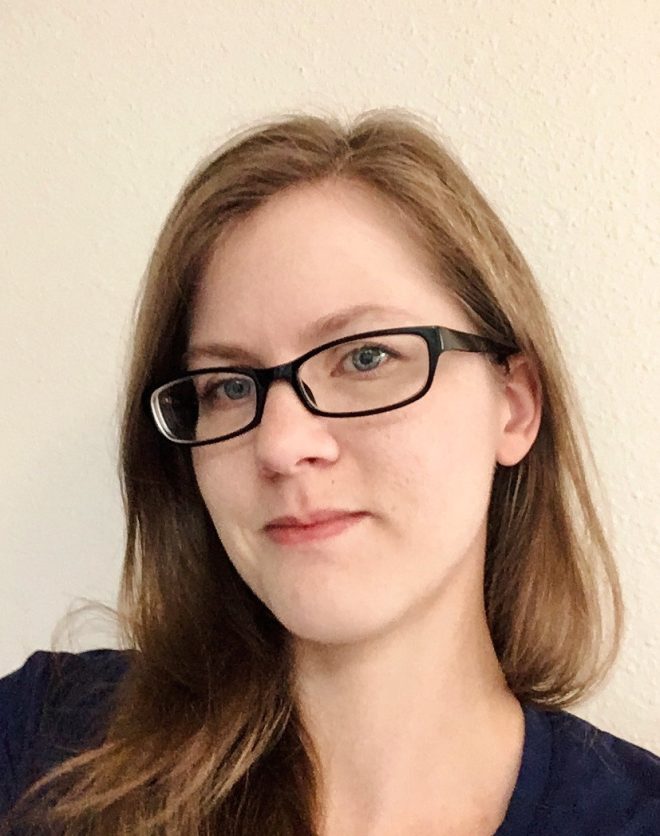
As a fine art professional, Mar has wielded katanas and handled Lady Gaga’s shoes. As a veterinary assistant, she has cared for hairless cats, hedgehogs, and, one time, a coyote. As a writer, her short fiction can be found in Analog, Strange Horizons, Escape Pod, and many other publications. She is a reader for Interstellar Flight Press and Diabolical Plots and a graduate of the Wayward Wormhole. She resides in the Pacific Northwest or can be found on various social media @MaroftheBooks.
About the Narrator
Rosie Sentman

Rosie Sentman is an actor, voice actor, singer, and all around ‘theatre artist’, originally from Georgia and now living in Boston, Massachusetts. You can find more about their projects and contact them at rosiesentman.com.
