

PodCastle 928: FLASH FICTION EXTRAVAGANZA: Things Left Unsaid
Show Notes
Rated G
Peppermint Tea
by Rachel Gutin
Simi huddled in their borrowed coat and tried not to shiver as they reached for the stuffed roll their housemate had set out for them. No matter how many down coats and thick woolen sweaters Kari lent them, they couldn’t shake the chill from their bones. They ached to be back home, where winter never got this cold.
But home meant Gran, and Gran was gone now. Had it really been six weeks since she died?
At least the roll was fresh from the oven, blessedly hot. The soft, spongy bread compressed between their teeth, releasing a burst of rosemary and olive. The savory beef filling warmed them from the inside out.
As they ate, they watched Kari flit around the kitchen, murmuring to herself about this measurement or that flavor. Kari had served Simi so many new foods, but it was her process that fascinated them the most.
Culinary alchemy. That was what Kari called it. Mix a pinch of this with a dash of that, ingredients that bore only the vaguest resemblance to the desired outcome, one for each significant trait: color, texture, flavor. Kari made hot cocoa from stale breadcrumbs and brown sugar, or ground beef from mushrooms, cherries, and oats.
And she was quick about it too. Five minutes of prep, then into the oven or frying pan it went. Back home, the same dishes would have taken hours.
Kari set out a row of glass prep bowls. “There’s real mint this time,” she said. “I found some at the market.”
Simi stared intently at the wisps of steam curling up from inside their roll. “Okay.”
“For the tea,” Kari added, as if that weren’t obvious.
“Sure.”
Ever since Simi got the news six weeks ago, Kari had been trying to replicate Gran’s tea. As if getting it just right might somehow heal the gaping wound in Simi’s heart.
“Whole or crushed?” Kari asked.
“How should I know?” Simi had enjoyed Gran’s tea countless times, but they’d never paid attention to how Gran made it. Not the way they paid attention when Kari cooked.
Kari sighed. “I really wish she’d written down the recipe.”
“She never liked to make things easy.” If she had, she wouldn’t have been Gran. Simi dared to glance back up. “I wish you could’ve met her, though. She would’ve liked you.”
Kari’s pale cheeks flushed a vivid red. “Liked me enough to teach me how to make this tea?”
Simi barked out a single startled laugh. “As if.”
“Well, let’s try whole leaves this time.” She lifted a shopping crate onto the counter. “No fresh ginger today. No lemons either. But I found some mandarins.” She held up the bumpy orange fruit like a prize, then grabbed a microplane and started zesting. Next came a bulbous yellow root vegetable. Kari scraped at it with a peeler, and shavings tumbled into the bowl. And . . . was that brine she’d just opened?
“Color, acid, tang,” Kari murmured as she sprinkled in the liquid. She grabbed a clean mixing wand from the holder by the sink and tapped it on the edge of the bowl three times, then started stirring. Her quiet murmur shifted into her usual wordless chant, and static prickled at the roots of Simi’s hair.
Something popped as the spell coalesced, and Simi blinked. When they looked again, the bowl contained a heap of yellow powder, nearly as bright as Gran’s finest lemons.
As Kari set to work on the ginger, anticipation squeezed at Simi’s chest. Would this be the time she finally got it right? Was that even possible without fresh mint from the corner of Gran’s garden? Without a lemon from the tree in the yard?
Was it possible to make Gran’s tea without being Gran?
Still, Simi watched intently as Kari set a kettle on the stovetop and lined up two ceramic mugs on the counter to her right. She measured powder into each of them, then added a few mint leaves. The kettle whistled and she filled both mugs to the rim, then brought them to the table.
As Simi wrapped their hands around a mug, the familiar aroma caught them off-guard, enveloping them like one of Gran’s giant hugs. Even so, they hesitated, not sure they could face the inevitable let-down when the flavor once again fell short.
But this was Kari sitting across from them. Kari, who always tried so hard.
They took a single cautious sip, and . . .
It was home.
The tea was Gran’s kitchen, brewed and distilled into this plain white mug, and tears ran down their cheeks as they swallowed. Was it exactly right? No. But it was so very, very close. It was the freshness of the mint that Gran grew in her garden. The tartness of the lemons she picked from the yard.
It was Gran’s arms, wrapped around them, squeezing too tightly. Gran’s voice insisting that yes, they should leave home. “Go. You deserve a proper education.” And never mind that Gran didn’t tell them she was dying. Never mind that they couldn’t make it back to say goodbye.
It was . . .
No.
It was just a cup of tea.
It was magic powder and a couple of mint leaves and it had no right to make them so upset.
They wiped their eyes on the sleeve of their borrowed jacket.
“Simi? What’s wrong? Is it really that bad?”
“No. It’s good. It’s . . . just right.” They forced down one more sip, as slow and deliberate as a careful goodbye, then pushed the mug away. “Please don’t make it again.”
Kari opened her mouth to speak, then changed her mind. She reached across the table to squeeze Simi’s hand. “Want some hot cocoa instead?”
Simi nodded gratefully, and even managed a watery smile. “That sounds perfect.”
They polished off the last of the stuffed roll, licking crumbs from their fingers as Kari grabbed a fresh wand and some scraps of stale bread. Soon enough, the smell of cocoa mingled with the peppermint and lemon, soothing away the last of their tears. Hot cocoa was Kari’s drink, as much as tea was Gran’s. It was a drink for this home, and as Simi breathed it in, they settled deeper into their seat, relaxing into the aroma’s warm embrace.
Ghosts
By Christina N. Trujillo
There is a ghost in my kitchen. She’s standing behind me.
While I peel the plantains, she leans forward and asks, “Why didn’t you love me? Why? Why? Why?” I ignore the question. Ghosts don’t like to leave once you’ve acknowledged they’re there. I made that mistake with the ghost in my living room already.
The living room ghost always sits on the couch. She’s knitting a scarf or a sock or something. I don’t know. I don’t knit, and I never did ask what she was working on back when I had the chance. Sometimes she’s wearing a fuzzy pink sweater. Sometimes she’s in a hospital gown. She used to shout at me when I left for work.
It’s December now. I’ve been home since April.
She doesn’t shout anymore.
Over the sound of oil spitting in the pan on the stove, she reminds me, “You should have come to see me more. You should have come. You should have come. You should have come.”
I said I was sorry.
She won’t leave.
I’ve been ignoring the kitchen ghost since last December, but she hasn’t left either.
Sometimes the kitchen ghost looks the way I remember her last — skin so thin I can see the veins beneath, hair dyed a vibrant brown that doesn’t balance the carefully applied blue eye shadow — and sometimes she looks nothing at all like I remember her. She looks young, full of curves, with her hair a natural color than I never got to see.
The only things that never change are her eyes, so I make sure not to even look at their reflection in the glass door of the microwave above my head.
I’m trying to make bolón de verde.
I’m following a recipe.
My ghost in the living room keeps repeating, “You should have come. You should have come. You should have come.” It makes a rhythm that I follow as I slice the plantains.
The last time I went with my mother to my grandmother’s house in LA, I saw another ghost. He was following my grandmother until he finally sat at the head of the dining room table to watch my mother and grandmother. I tried to talk to him. Tried to say those things I didn’t when he was still there and I thought I had time.
He wouldn’t speak to me. He wasn’t my ghost.
The recipe says I’m supposed to let the plantains cook first, so they get soft enough to mash. Last time I tried to make this, I didn’t let them cook long enough. I’ve only had the dish once, when I was very young. It’s the only thing I remember my abuela cooking, but I still remember how the little plantain balls tasted when she made them. Mine were too salty, and the plantains were hard.
There’s a trick to cooking them well, a specific shade the little bits turn that tells you they’re ready to be scooped out and mashed up. I didn’t know that. No one ever told me, and it isn’t written in the recipe.
This time, I’ve set an alarm.
Oil pops from the pan as I put the cut-up pieces in.
A drop falls on my finger. It burns.
I curse and shake my hand. When I move to hold my finger under cold water, the ghost moves with me. I see her out of the corner of my eye, old and young, familiar and strange, looking from my hand to the stove.
I saw her kitchen once. The one my father grew up in, in that old house back in New Jersey. I know more about the house than I ever did about her. I know she protected it fiercely, even when she hated it, because the house was hers when so little else in this country was.
I know there is a correct emotion I’m supposed to feel when I hear the stories of how she ripped up foreclosure notices and stood in front of bulldozers to fight for her home. I’m supposed to feel proud.
Instead, I get angry. Instead, I think, “Why? Why? Why?”
I can tell now, who’s going to end up a ghost. My great-uncle will be my mother’s ghost. He’ll step in her footprints chanting, “If only I’d known, things might be different. Might be. Might be. Might be.” My father has too many ghosts to hear them all. Their unending drone stuffs his ears until the voices of the living are only whispers.
My older sisters will haunt me, their voices mingling until it becomes impossible to know who tells me, “You should have said something. You should have. You should have. You should have,” and “I’m not sorry. I’m not. I’m not. I’m not.” A man whose face I tell myself I forgot will join them to linger in the corner of the room and repeat, “Can you forgive? Can you? Can you? Can you?”
The alarm goes off on my phone.
I turn off the water and go back to the plantains.
They’re ready to flip now.
My ghost rests her cheek against my shoulder the way I remember her doing, back when I was very little. I shiver.
“Why didn’t you love me?” she asks again. “Why? Why? Why?”
I’m following her recipe.
Last Word
by Toshiya Kamei
The silence was heavy, thick with the dust of thirty years. Maeve held the receiver so tightly her knuckles were white stones. On the other end, a continent away, was Lira. The only other person in the world who would understand.
“Maeve. What a ghost you are.”
“Old Borin died,” Maeve said, skipping pleasantries they no longer owned. Her voice was a stranger, the Kaelan words brittle in her mouth. “On Tuesday. His heart.”
A longer silence now. Borin, with his whistling laugh and hands stained permanently with fish gut. The third last speaker. Now, there were two. An empire of sound and syntax reduced to a single, fraying telephone wire.
“So,” Lira’s voice came softer now. “We’re the last.”
“The last,” Maeve affirmed. The words felt like closing a heavy book.
They had learned Kaelan at their grandmothers’ knees, a language of sea spray and mountain shadow, with seventeen words for the particular shade of twilight over the bay and no word for “goodbye,” only sián-valen — go gently. They had whispered to each other in the hayloft, their young bodies mapping a new geography onto the ancient grammar. Lira’s hair had smelled of sun and wild thyme. Maeve had traced the script of Kaelan poems onto Lira’s back with a fingertip.
“Do you remember,” Maeve began, her voice cracking, “the word for it? Sael-féin?”
A wounded sound from Lira, not quite a laugh, not quite a sob. “A single, perfect word for the way sunlight wove through the high branches of the sea pines.”
The sterile quiet of Maeve’s cottage disappeared. She was seventeen again, lying on a bed of pine needles, Lira’s head in her lap. The light was just so, a golden net catching them, and Lira had looked up at her and said the word, Sael-féin, and it had meant not only the light, but the moment, and the feeling, and the impossible, breathtaking fact of them.
“I remember,” Lira said, her voice thick. “We were children trying to speak the language of forever. We didn’t know it had no future tense.”
That was the heart of it. The fight that had torn them apart had been in the harsh, clumsy tongue of the city Lira had fled to. In Kaelan, they had never argued. The language was too gentle for it, too precise in its poetry to allow for the blunt cruelty of their breakup. They had needed another language to destroy each other.
“I’m trying to write it all down,” Maeve confessed, looking at the stacks of paper on her desk, a dictionary for a world of two. “But I forget things. The lullaby your grandmother sang . . . the one about the moon eels. I can only remember the first line.”
Lira was quiet for a moment. And then, she sang. Her voice was lower now, roughened by time and city air, but the melody flowed as clear as spring water. It was the song, the whole song, about the silver eels who swam up the river of night to kiss the moon. Maeve closed her eyes, tears tracking paths along her cheeks. She picked up a pen and wrote, her hand flying across the page.
They talked for an hour. They spoke of noun declensions and forgotten proverbs. They resurrected jokes that hadn’t been funny for half a century. They didn’t speak of the thirty years of silence, of the husbands and heartaches that had filled the void. They spoke only Kaelan, and in doing so, they rebuilt the small, beautiful world they had once shared. It was a world that now fit on the head of a pin, precious and impossibly fragile.
“I have to go,” Lira said finally. The outside world, with its different tongue, beckoned her.
“Will you . . . sián-valen?” Maeve asked, using the old phrase. Go gently.
“Yes,” Lira whispered. “You too.” A pause, then one more word, a word that hung in the air like a hummingbird, heavy with the ghosts of everything they had been and everything they had lost.
“Amárra,” Lira said. Beloved.
Maeve didn’t reply. She held the receiver until the line went dead, listening to the static hiss of the present. But for the first time in thirty years, she wasn’t alone in it. Filled with the echo of a word, the silence was no longer empty.
Host Commentary
Christina sent us this note on her story today: I wrote this story during the height of the pandemic after far too much time alone with my own thoughts. The idea that the things we didn’t say to one another felt like a persistent haunting kept coming back to me, and so this story came about. Writing the story helped chase away a few of my ghosts.
Thank you to all our authors today for their stories. Devin and I bounced around a few ideas for the title of this episode, trying to capture what ties them all together: we started off thinking about regret, but I think we got to the more specific emotion in the end with “Things Left Unsaid”.
I am probably not the best qualified person for this topic, what with my oft-discussed neurodivergence. I am both terrible at talking to people and fully understanding everything being communicated back to me, and also heavily afflicted by a lack of friendship decay—which is, I can have gone a decade or more without talking to someone and still assume we are exactly where we left off, probably because I’ve not even noticed it’s been a decade.
But then I am also, by dint of that neurodivergence, someone who obsesses over and clings to moments of regret. Who constantly replays the things I said and shouldn’t have, or the things I didn’t say and should have: the moments and the people I miss, the paths I didn’t walk, the things that are beyond me forever now.
I try to live by the mantra better to regret the things you did than the things you didn’t. Not because I am trying to justify my carefree, carpe diem character to others (because that doesn’t exist): because I am trying to remind myself of the lesson I’ve learned the hard way so many times, and that I need to fight my natural instinct to shy away, to play it safe, to stay within known bounds. To remember that life is too short, and that there is no time like the present, and that we too often let little, unimportant things get in the way of what really matters.
The world will forever keep putting barriers in our way, keep trying to steal from us for its own sake. If we don’t pay attention, it will steal more than you ever realise, until it’s too late to fix it. That’s a fight that requires constant vigilance, so after listening to these stories today, here’s your homework: go and do one thing today that matters to you, and not to the world. Call someone, see someone, open that bottle you were saving, see that sight you’ve been meaning to, start that book or take that photograph or whatever first comes to mind right now when you think: what would I regret if I never had the chance.
About the Authors
Christina Trujillo

Christina Trujillo was a semi-finalist in the 2013 Galaxy Press Writers of the Future competition, a recipient of the Glimmer Train 2013 Top 25 in Short Story Award for New Writers, and a 2020 Hermana with Las Musas. Her YA novels Burnt and What Remains have been long-listed for the Voyage Summer 2021 and Spring 2021 First Chapter Contests. Her work has appeared in Dark Phrases, Glassworks Magazine, Gingerbread House, and Dynamite Entertainment. When not writing, Christina teaches English, enjoys hanging out with her two cats, and loves cooking (but not baking — she’s not allowed to bake. Not after The Incident)
Rachel Gutin
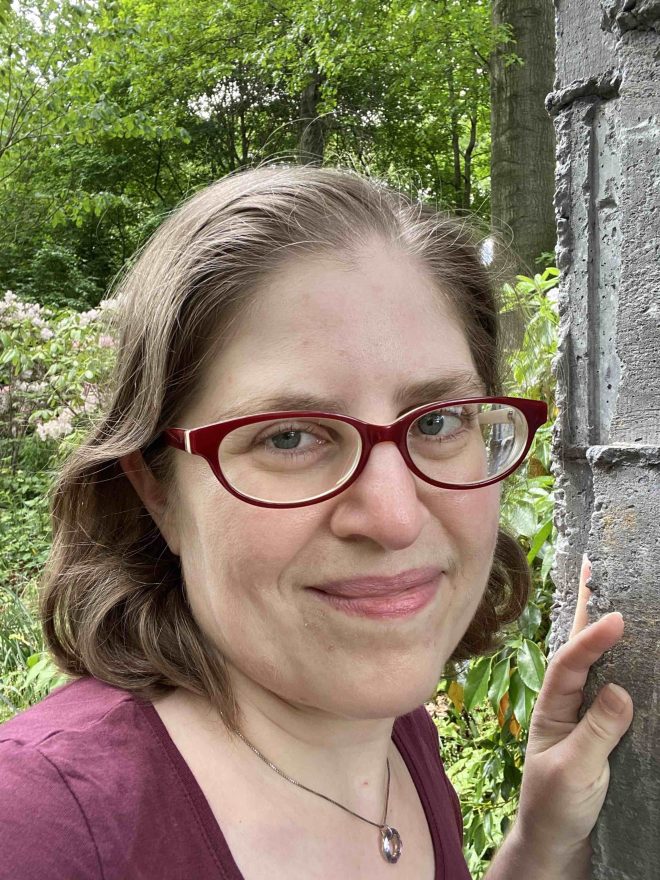
Rachel Gutin is a writer and special education teacher. Her short fiction has appeared in a number of publications including Escape Pod, Cast of Wonders, and Small Wonders. She lives in Brooklyn, NY, and is a member of the organizing team for Brooklyn Speculative Fiction Writers. You can find her online at rachelgutin.wordpress.com.
Toshiya Kamei

The translator for this story, Toshiya Kamei, is a writer whose short fiction has appeared in Bending Genres, New World Writing, and Utopia Science Fiction, among others.
About the Narrators
Jess Lewis
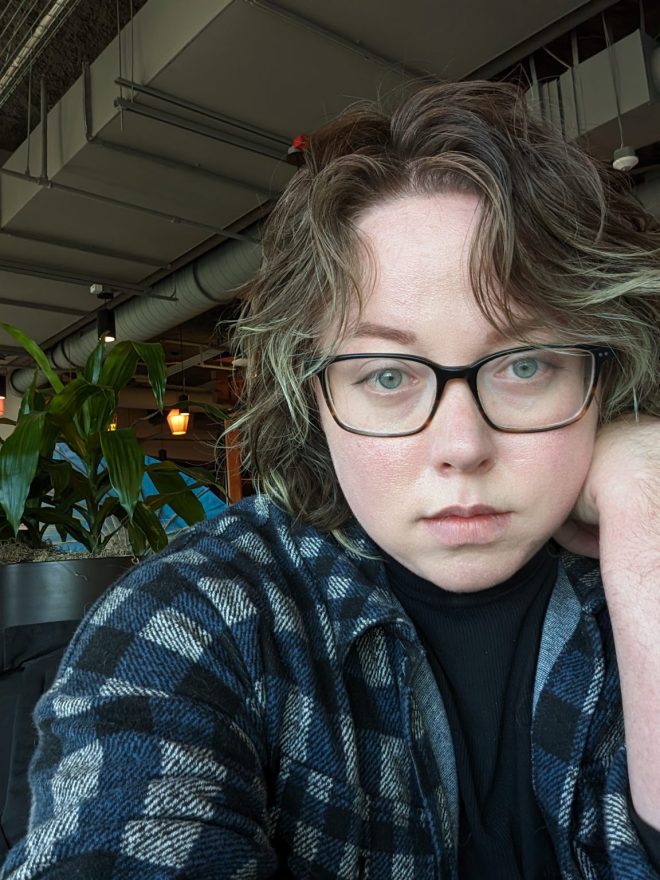
Jess is a trans non-binary and pansexual writer, designer, and voice actor who hails from the hollers of Western North Carolina. They currently live in the deep South, where they explore futures of liberation and how to get there.
When they’re not imagining weird queer cli-fi utopias, designing future tech, or facilitating capacity-building workshops, they’re organizing programming with their local queer community and The Outer Dark Symposium on the Greater Weird. Their work has appeared in a range of publications, including Solarpunk Magazine, HyphenPunk, and Kaleidotrope.
You can visit their website at https://www.quarefutures.com and follow them on Instagram @merrynoontide
Amal El-Mohtar

Amal El-Mohtar writes fiction, poetry, and criticism. She won the Hugo, Nebula, and Locus Awards for her short story “Seasons of Glass and Iron” and again for her novella This Is How You Lose the Time War, written with Max Gladstone, which also won the BSFA and Aurora awards, became a New York Times bestseller, and has been translated into over ten languages. Her reviews and articles have appeared in the NYT and on NPR Books. The River Has Roots, her solo debut, is out now from Tordotcom Publishing. She lives in Ottawa, Canada. Online at: amalelmohtar.com.
Sandra Espinoza

